What Wasp Is This? Identify Wasps, Hornets and Nests
Most people call anything striped a wasp, and the difference matters. Our AI separates paper wasps, yellowjackets, hornets, mud daubers and solitary wasps from bees and hoverflies, and identifies nests by their shape and where they are built.

- Free to try
- No sign-up
- Results in seconds
Take or upload a photo
AI identifies anything in seconds
1 free identification, no account needed
Wasps split into two groups that behave completely differently. Social wasps live in colonies, build paper nests, and defend them, and this is where nearly all stings come from. Solitary wasps live alone, build mud cells or burrows, and almost never sting people. Knowing which group you are looking at answers most of what people actually want to know.
Below are the wasps and nests found around houses and gardens most often, and how each behaves. Photograph from a distance and zoom in rather than getting close.
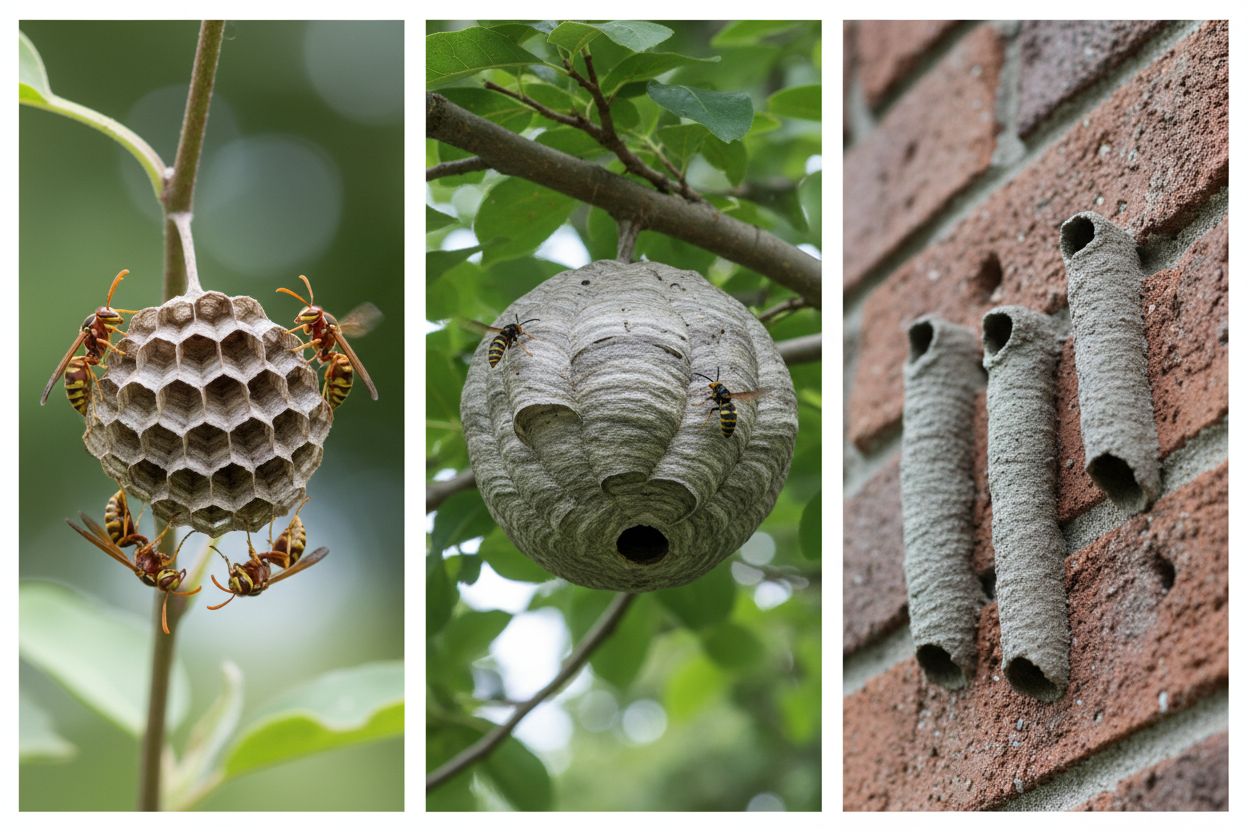
Common types of wasps
A quick reference to the ones people ask about most. Not sure which you have? Snap a photo above and let the AI name it.
Paper wasps
Slim, long-legged, with legs dangling in flight. Build small open honeycomb nests on a stalk under eaves. Fairly docile unless the nest is touched.
Yellowjackets
Compact, bright yellow and black, and the ones at your picnic. Nest in the ground or in wall cavities and are the most aggressive of the common species.
Hornets
Much larger, often brown and yellow or black and white. Build big enclosed paper nests in trees or lofts. Powerful sting and a strong nest defence.
Mud daubers
Long, thread-waisted and often metallic blue or black. Build hard mud tubes on walls. Solitary, non-defensive, and genuinely harmless.
Solitary and digger wasps
A huge and varied group nesting in burrows or hollow stems. They hunt other insects and have no colony to defend.
Hoverflies
Not wasps at all. Flies that mimic wasp colouring for protection. They have one pair of wings, huge eyes, no waist, and cannot sting.
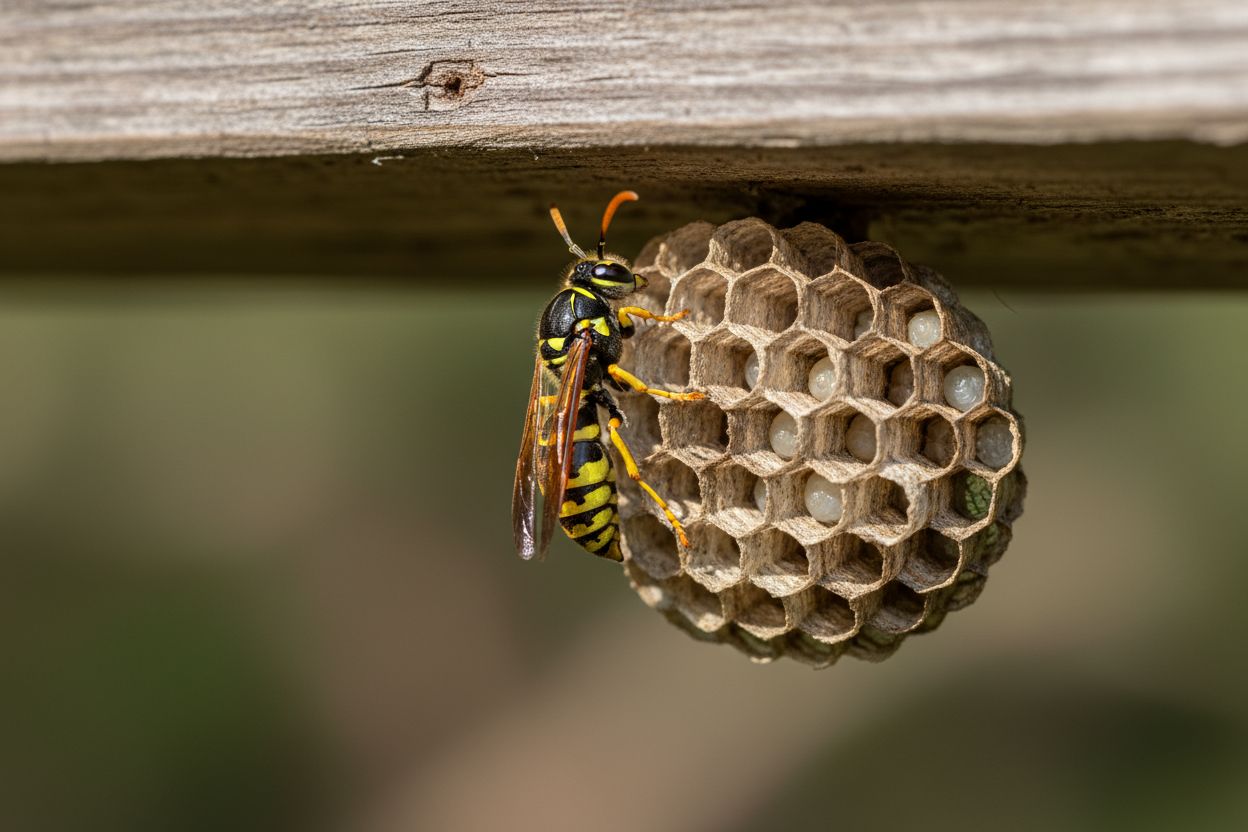
Why identifying wasps matters
How you should respond depends entirely on which insect it is. A mud dauber is solitary and harmless and can be left alone. A yellowjacket nest near a doorway in late summer is a genuine problem. Bees are protected in many places and should never be sprayed. Getting the identification right decides whether you call someone, do nothing, or move the nest.
What helps identify wasps
Waist and Body Shape
Wasps have a sharply pinched waist and a smooth, shiny body. Bees are rounder and visibly hairy. This is the fastest way to tell them apart.
Markings
The pattern of yellow, black, white or red bands, and the face markings, separate species that are otherwise very similar in shape.
Nest Shape and Material
An open honeycomb on a stalk, a closed grey paper ball, a mud tube, or a hole in the ground. Each belongs to a different group.
Nest Location
Eaves, wall cavities, underground burrows, tree branches and sheds each attract different species and each changes the risk.
Size and Flight
Hornets are noticeably larger. Hoverflies, which mimic wasps closely, hang motionless in the air in a way no wasp does.
Wasp, bee or hoverfly?
Three lookalikes and three clear tells. A wasp has a sharply pinched waist, a smooth glossy body, and legs that dangle when it flies. A bee is round and covered in visible hair, often with pollen on its legs, and it works flowers methodically. A hoverfly has no waist to speak of, enormous eyes covering most of its head, and it hangs perfectly still in mid air, which neither of the others does. Only the wasp and the bee can sting, and only the wasp is likely to.
Photo tips for the best identification
- 1Photograph from a safe distance and zoom in rather than approaching. Do not photograph a nest at close range in late summer.
- 2If you can only get the nest, that is often enough. Nest shape is highly diagnostic on its own.
- 3Note the size against something familiar, and say whether the insect was alone or part of a group.
- 4Say what it was doing. Chewing wood, digging in soil, hovering by a flower and patrolling a bin all point to different species.
Frequently asked questions
Is this a wasp or a bee?
Look at the waist and the hair. Wasps have a sharply pinched waist and a smooth shiny body. Bees are chunkier, visibly furry, and usually carrying pollen. Photograph it and the AI will tell you which, which matters because bees should not be treated as pests.
What kind of nest is this?
An open honeycomb hanging from a short stalk is a paper wasp. A closed grey papery ball is a yellowjacket or hornet. A hard mud tube is a mud dauber and harmless. A hole in the ground with traffic in and out is usually a ground nesting yellowjacket.
Is this wasp dangerous?
It depends on the species and the season. Solitary wasps rarely sting people. Social wasps defend their nest and get markedly more aggressive in late summer when the colony is large and the food runs out. The AI flags how defensive a species typically is.
Should I remove the nest myself?
Small early-season paper wasp nests and mud dauber tubes are usually manageable. A mature yellowjacket or hornet nest is not, and disturbing one can bring hundreds of stings. If the nest is bigger than a fist, or inside a wall, or anyone nearby is allergic, call a professional.
Identify wasps on the go
Get the What Is This app for unlimited scans, offline mode, and a history that syncs.