Hornet vs Wasp: What Is the Difference?
"Hornet" is not the opposite of "wasp." Hornets are one group of wasps, the large ones in the genus Vespa, the same way robins are one group of birds. In the US, people use "hornet" for any big, scary wasp, which is why the question gets confusing. The useful answer is to skip the labels and learn the five or six species you will actually meet.
The species, by name and by what people call them
| Insect | Really a | Size | Look |
|---|---|---|---|
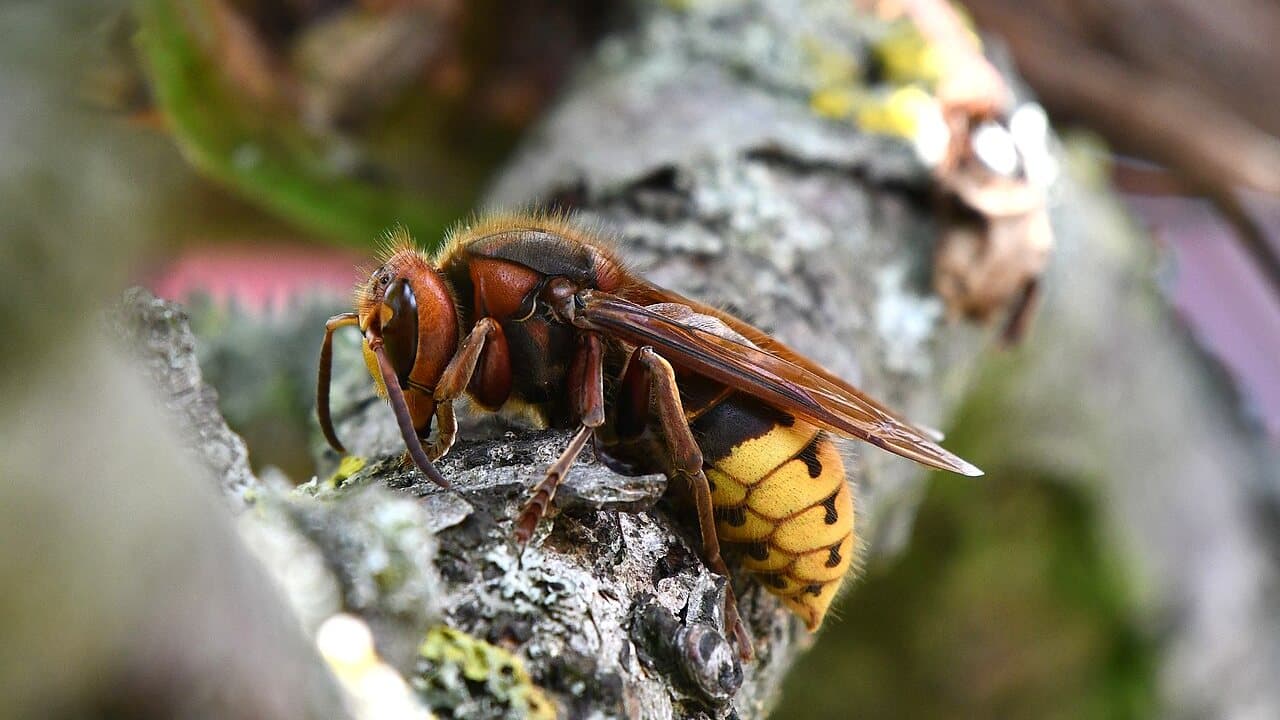
| European hornet | True hornet | About 1 to 1 1/2 inches | Reddish brown head and thorax, yellow abdomen with brown bands |
| Bald-faced hornet | Yellow jacket (not a true hornet) | About 3/4 inch | Black with ivory white face and markings |
| Yellow jacket | Wasp | About 1/2 inch | Bright yellow and black, smooth and shiny |
| Paper wasp | Wasp | About 3/4 to 1 inch | Slender, brown or black with yellow or red marks, long dangling legs |
| Mud dauber | Wasp | About 1 inch | Black or metallic blue, waist thin as a thread |
| Cicada killer | Wasp | About 1 1/2 inches | Huge, black or rust with pale yellow bands |
| Northern giant hornet | True hornet | About 1 1/2 to 2 inches | Orange head, dark eyes; found only in the Pacific Northwest and declared eradicated |
The cicada killer is the insect behind most "giant hornet" reports in the eastern and central US. It is a solitary ground-nesting wasp that hunts cicadas in midsummer, looks terrifying, and rarely stings anyone. Males, which patrol lawns and buzz people, cannot sting at all.
How to tell a true hornet from other wasps
For the one true hornet most Americans will see, the European hornet, three things stand out:
- Size and color. Bigger than any yellow jacket, with a brown and reddish front half instead of black and yellow.
- A wide head. The head behind the eyes is broad, wider than on paper wasps or yellow jackets.
- Night flying. It is the only common wasp that flies after dark and bangs into lit windows. A big striped insect on your porch light at 10 p.m. is a European hornet.
Paper wasps are the easiest wasp to tell from a hornet: long, thin bodies and long legs that hang down in flight. Mud daubers have a waist so thin it looks like a wire. Yellow jackets are smaller and brighter than any hornet.
Read the nest
Nests often identify the insect faster than the insect itself.
| Nest | Where | Belongs to |
|---|---|---|
| Gray paper football, enclosed, with one entrance at the bottom | Hanging in trees, shrubs, under eaves | Bald-faced hornet |
| Brown papery nest, enclosed, inside a cavity | Hollow trees, wall voids, attics, sheds | European hornet |
| Open umbrella of cells, no cover, hanging from a stalk | Under eaves, deck rails, grill lids | Paper wasp |
| Hidden underground, busy hole in the lawn | Lawns, banks, under shrubs | Yellow jacket |
| Hard mud tubes or lumps | Walls, ceilings of porches and garages | Mud dauber |
| Single hole with a fan of loose soil, often many in one patch | Sunny lawns, sandy banks, edges of patios | Cicada killer |
Which ones to worry about
| Rank | Insect | Why |
|---|---|---|
| 1 | Yellow jacket | Large colonies, ground nests that people mow over, and late-summer interest in your food |
| 2 | Bald-faced hornet | Defends its aerial nest aggressively and in numbers; can squirt venom toward the eyes |
| 3 | European hornet | Big and painful, but defends mainly at the nest and is otherwise not aggressive |
| 4 | Paper wasp | Stings if you bump its nest; small colonies |
| 5 | Mud dauber, cicada killer | Solitary; almost never sting people |
The ranking runs opposite to how scary they look. The cicada killer is the biggest and the least dangerous. The yellow jacket is the smallest on the list and causes most of the stings.
Get a photo, from a distance
A clear photo of the insect, or of the nest, is usually enough. The wasp identifier separates European hornets, bald-faced hornets, paper wasps and yellow jackets well from a sharp side or top view, because the color patterns differ so much. A photo of the nest works too and is often easier to get safely. It struggles with insects in flight, blurry zoomed shots, and nests seen from directly below where the shape is hidden. Do not get close to a bald-faced hornet nest for a better picture; a phone zoom from 15 feet is plenty.
The season changes the risk
| Season | What is happening | Risk |
|---|---|---|
| Early spring | A single queen starts a nest the size of a golf ball | Low; the best time to remove a nest in a bad spot |
| Early summer | Workers hatch and the nest grows quickly | Rising |
| Late summer | Colonies at peak size; yellow jackets switch to sugar and scavenging | Highest; most stings happen now |
| Fall | Workers die off; new queens leave to hibernate | Falling, ends with the first hard frosts |
| Winter | Nests are empty and are not reused | None; old nests can be taken down safely |
This is why a gray paper nest discovered in a tree in November is not a problem: it is already empty. The same nest in August deserves respect, and so does a nest you find in spring that is already the size of a basketball.
Signs of a nest inside a wall
European hornets and yellow jackets both build inside walls, attics and soffits. The signs are a steady stream of insects going in and out of one gap in the siding, trim or a vent; a rustling or chewing sound inside the wall, louder on warm days; and sometimes a damp or discolored spot on interior drywall as the nest grows. Do not seal the entrance from outside. Blocked insects chew toward the light and can come through the drywall into the room. Have the nest treated through the entrance, then seal it after the colony is dead.
If you are stung
Wasps and hornets do not leave a stinger behind, so there is nothing to remove. Wash the area, use a cold pack, and take an antihistamine for itching and swelling. Swelling that spreads several inches around the sting over the next day is a common large local reaction and not, by itself, an allergy. Get emergency help right away for hives away from the sting, swelling of the lips or throat, wheezing, dizziness or vomiting, and for anyone stung many times at once. A European hornet sting is more painful than a yellow jacket's because of its size, but the venom is not more dangerous.
What to do about each
- Bald-faced hornet nest near a door or path: have it removed, ideally at night by a professional. Away from people, leave it; the colony dies in fall and the nest is not reused.
- European hornets in a wall: a professional job, because the nest is inside the structure. They also strip bark from lilacs and birches, which explains damaged shrubs in late summer.
- Paper wasps under the eaves: small nests can be knocked down early in spring before they grow. Otherwise leave them; they eat caterpillars in your garden.
- Cicada killers and mud daubers: leave them. They are not a threat.
For the small yellow wasp at your soda, see the yellow jacket vs bee guide.
Frequently asked questions
Is a hornet a wasp?
Yes. Hornets are a group of large wasps in the genus Vespa. In the US the only common true hornet is the European hornet. The bald-faced hornet is actually a type of yellow jacket despite its name.
Which is more aggressive, a hornet or a wasp?
It depends on the species, not the label. Bald-faced hornets and yellow jackets defend their nests hard. European hornets and paper wasps are less defensive. Mud daubers and cicada killers almost never sting people.
Are murder hornets in the US?
The northern giant hornet was found in Washington State and British Columbia starting in 2019. After years of trapping and nest removal, Washington declared it eradicated in late 2024. A big hornet elsewhere in the US is almost certainly a European hornet or a cicada killer.
Do hornets come out at night?
European hornets do. They fly after dark and are attracted to lit windows and porch lights, which is one of the easiest ways to recognize them.