What Fossil Is This? Identify Your Find From a Photo
Cliff falls, quarries, ploughed fields and gravel driveways turn up fossils constantly, and most people have no idea what they are holding. Our AI names the likely group, ammonite, brachiopod, crinoid, shark tooth, coral, plant, estimates the geological period, and flags the shapes that only look organic.

- Free to try
- No sign-up
- Results in seconds
Take or upload a photo
AI identifies anything in seconds
1 free identification, no account needed
Fossils are recognised by pattern. Life repeats itself in ribs, chambers, segments and spirals, while geology tends toward the random. That single distinction handles most of the question of whether a find is a fossil at all, and the host rock then does most of the work of dating it.
Below are the fossils that turn up most often in gardens, on beaches, and in quarry spoil. Photograph yours with something for scale and say where it came from.
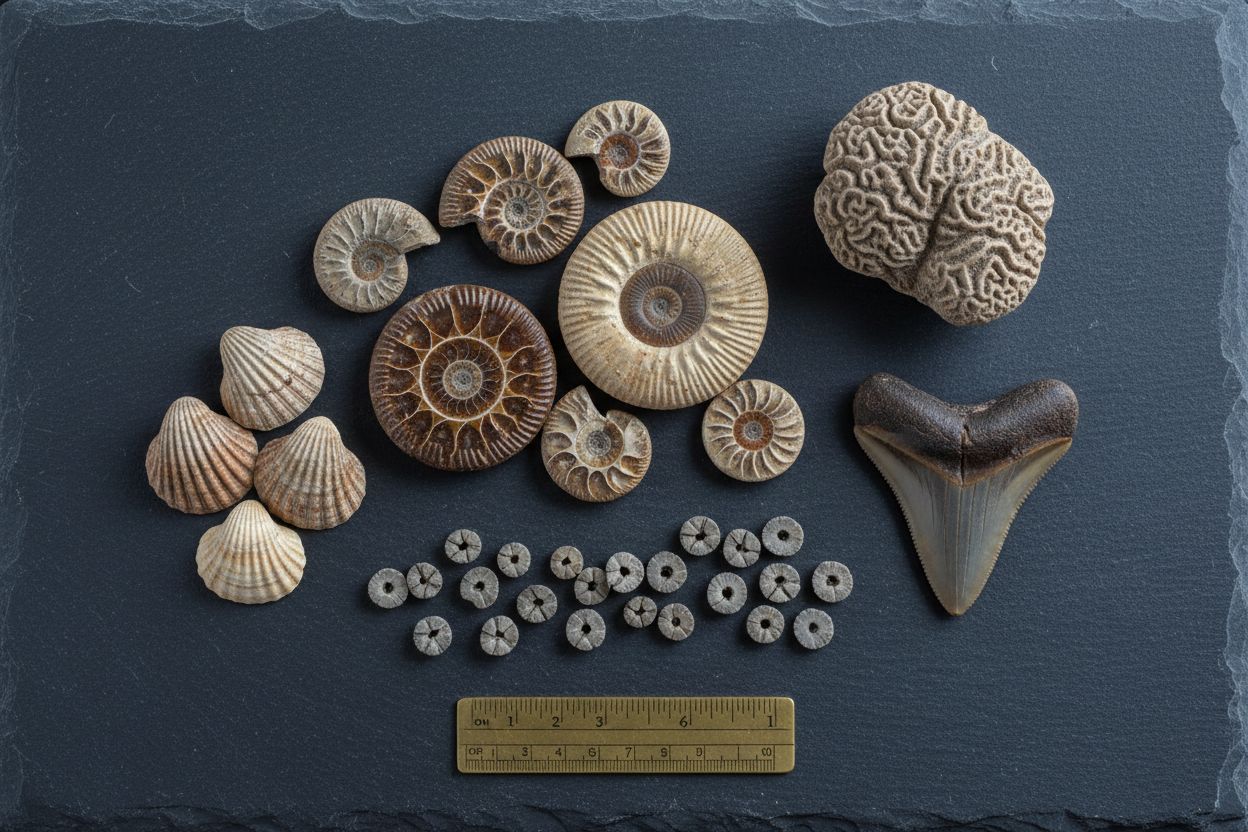
Common types of fossils
A quick reference to the ones people ask about most. Not sure which you have? Snap a photo above and let the AI name it.
Ammonites
Coiled, ribbed shells from extinct marine molluscs. Jurassic and Cretaceous, and among the most recognisable fossils anywhere.
Brachiopods and bivalves
Two-shelled creatures, extremely common in limestone. Brachiopods are symmetrical across the shell, bivalves are symmetrical between the two halves.
Crinoid stems
Small stacked discs that look like tiny screws or beads. Fragments of sea lilies and one of the most common finds in Carboniferous limestone.
Shark teeth
Dark, glossy, triangular, and often found loose in gravel and on beaches. Preserved far more often than shark skeletons, which were cartilage.
Corals
Honeycomb or horn-shaped structures with fine repeating cells. Common in limestone and frequently mistaken for patterned stone.
Plant fossils and petrified wood
Leaf impressions in shale, and wood where the cell structure has been replaced by silica while keeping the grain visible.
Why identifying fossils matters
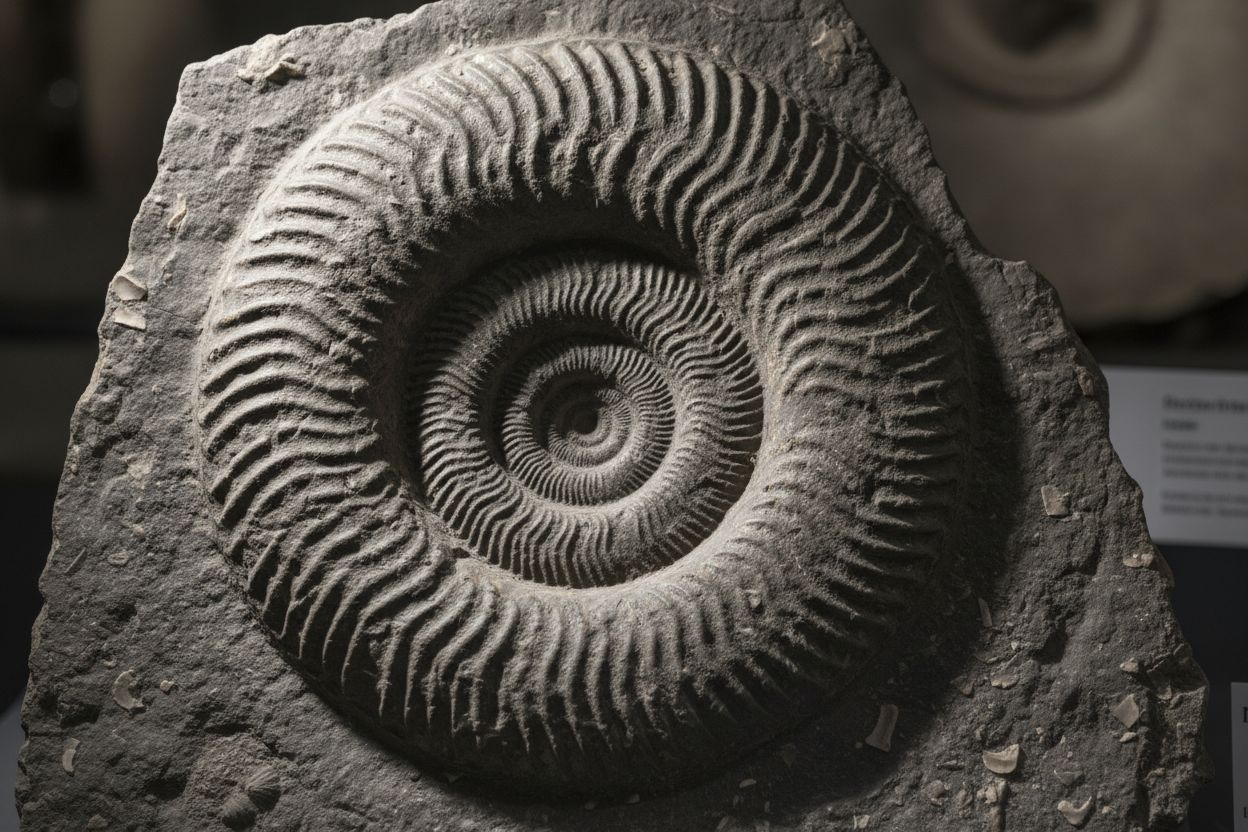
A fossil is a piece of a specific moment in deep time, and the identification is what gives it meaning. Knowing you are holding a 150 million year old ammonite rather than a curiously round stone changes what it is worth keeping for. It also matters legally, since some sites and some finds carry reporting obligations.
What helps identify fossils
Symmetry and Repeating Structure
Life builds in patterns. Spirals, ribs at regular intervals, radiating segments, and bilateral symmetry are the strongest signs something was once alive.
Host Rock
The rock the fossil sits in narrows the age enormously. Chalk, limestone, shale and clay each belong to particular periods and particular faunas.
Preservation Type
Whether you have the original shell, a mineral replacement, an internal cast, or just an impression in the rock changes both the look and the identification.
Size and Proportion
Many groups look alike at a glance and separate on measurements. A photo with a scale is worth far more than one without.
Where It Was Found
Local geology is decisive. The same shape means different things on a Jurassic coast and in a Carboniferous quarry.
Fossil or pseudofossil?
Nature produces plenty of shapes that fool people. Flint nodules form lumpy, bone-like forms. Concretions grow into spheres and discs that look like eggs or turtle shells. Manganese dendrites spread across rock in branching patterns that look exactly like fossilised ferns and are pure mineral growth. The test is repetition with structure. A real fossil has ribs at consistent intervals, chambers that shrink in proportion, or cells of even size. A pseudofossil is irregular the moment you look closely.
Photo tips for the best identification
- 1Always include a coin, a ruler, or your thumb for scale. Size separates species that look identical in a photo.
- 2Photograph both faces and the edge. Coiling, suture lines and cross-sections often carry the identifying detail.
- 3Wet the specimen or shoot it in raking side light. Low-angle light throws faint ribs and impressions into relief.
- 4Say where you found it and what the surrounding rock looked like. That single detail does more for the identification than any close-up.
Frequently asked questions
Is this actually a fossil?
Photograph it and the AI assesses whether the structure is organic, repeating symmetry and biological patterning, or geological, concretions, flint nodules and mineral growths that mimic life convincingly. It will tell you when the honest answer is that your find is a rock.
How old is my fossil?
Age comes from the rock, not the fossil. If you say where you found it and what the surrounding stone was, the AI gives the likely geological period, usually within a range of a few million years.
Can it identify shark teeth and ammonites?
Yes, and those two are among the most commonly found. Shark teeth are identified by crown shape, serrations and root form. Ammonites by coiling, rib pattern and suture lines where visible.
Am I allowed to keep a fossil I found?
It depends entirely on where you found it. Beaches and eroding cliffs are often fine, while nature reserves, scheduled sites and most public land in many countries are not, and some finds must be reported. Check the local rules before you collect, and never dig into a cliff face.
Identify fossils on the go
Get the What Is This app for unlimited scans, offline mode, and a history that syncs.