Rat vs Mouse: Size, Droppings and Signs
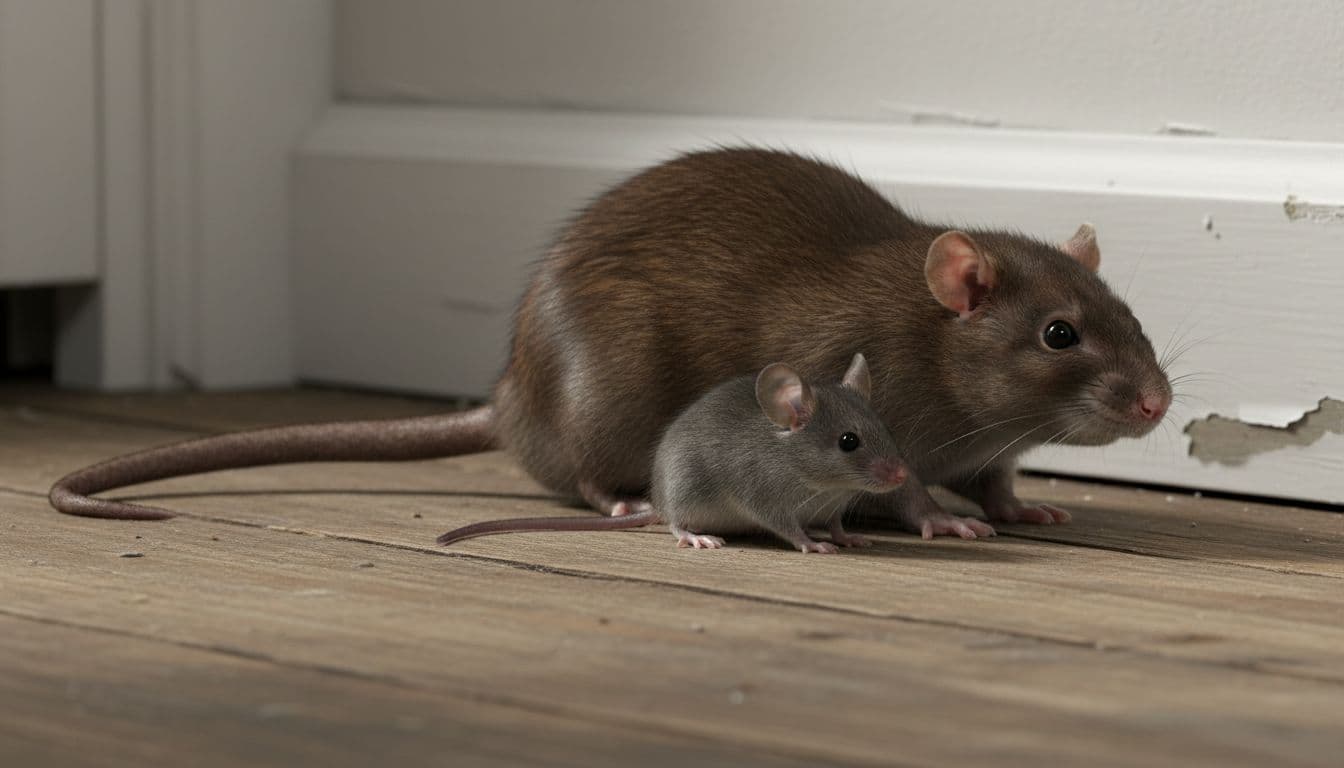
A rat is much bigger than a mouse: an adult Norway rat weighs roughly ten times as much as a house mouse and has a thick body, blunt nose, small ears and a heavy tail. A mouse is small and slender, with a pointed nose, big ears and a thin tail as long as its body. You will often not see either, though, so the droppings are the more useful evidence. They differ clearly in size and shape, and so do the holes, the gnawing and the way each one behaves around traps.
The animals side by side
| Feature | House mouse | Norway rat | Roof rat |
|---|---|---|---|
| Body length (without tail) | About 2 1/2 to 3 1/2 inches | About 7 to 10 inches | About 6 to 8 inches |
| Weight | About 1/2 to 1 ounce | About 7 to 18 ounces | About 5 to 10 ounces |
| Nose | Pointed | Blunt | Pointed |
| Ears | Large for the head | Small, close to the head | Large, thin |
| Tail | Thin, about as long as the body | Thick, shorter than head and body | Longer than head and body |
| Build | Slender, small feet | Heavy, stocky | Sleek, slender |
| Where in a house | Anywhere: walls, cabinets, drawers, appliances | Basements, crawl spaces, ground floors, burrows outside | Attics, upper walls, trees, climbing |
Norway rat or roof rat
The US has two common rats, and they live in different parts of a building. Norway rats, also called brown rats or sewer rats, are heavy burrowers. They live in the ground along foundations, under slabs and in sewers, and come into basements, crawl spaces and ground floors. Roof rats, also called black rats, are lighter and agile climbers. They live in trees, ivy, attics and upper walls, travel along fences, power lines and branches, and are most common in coastal and southern states, including California, the Gulf Coast and Florida. A rat in the attic in Phoenix or Miami is likely a roof rat; a rat burrowing under the shed in Chicago is a Norway rat. The fix follows from it: trapping and sealing low for Norway rats, trimming branches back from the roof and sealing the roofline for roof rats.
Young rat or adult mouse
The most common mix-up is a juvenile rat taken for a large mouse. Proportions solve it. Young rats have heads and feet that look too big for their bodies, like a puppy's paws, and their tails are already thick. Adult mice have small heads, delicate feet, oversized ears and long thin tails. If it looks like a baby, it is probably a young rat; adult mice look like miniature adults.
The droppings
| Droppings | Size | Shape | Points to |
|---|---|---|---|
| Many tiny dark pellets scattered along walls and in drawers | About 1/8 to 1/4 inch | Pointed at one or both ends, like rice grains | Mice |
| Fewer, larger pellets in groups | About 3/4 inch | Blunt ends, capsule-shaped | Norway rats |
| Medium pellets in attics and along high runways | About 1/2 inch | Pointed ends, slightly curved | Roof rats |
| Tiny specks like ground pepper in cabinets | Under 1/8 inch | Ridged or blunt | Small cockroaches, not rodents |
| Shiny pellets that crumble into insect parts | Similar to mouse | Pointed | Bats; crumble when crushed |
Fresh droppings are dark and soft; older ones turn gray and crumbly. Mice leave far more droppings, often 50 or more a day each, scattered wherever they travel. Rats leave fewer, larger ones along their regular routes.
Other signs
- Entry holes. Mice need a gap of only about 1/4 inch, roughly a pencil's width. Rats need about 1/2 inch, roughly a quarter. Holes with greasy, dark rub marks around them point to rats, which follow the same paths and leave body oil on walls and pipes.
- Gnawing. Mouse tooth marks are tiny and fine. Rat gnawing leaves larger, rougher marks and can chew through soft metal, wiring and plastic pipe.
- Sounds. Light scratching and skittering in walls is typical of mice. Heavier thumping and gnawing, especially in the attic at night, suggests roof rats.
- Burrows outside. Rats dig burrows about 2 to 4 inches across along foundations, under slabs and in garden beds, often with a fan of soil. Mice rarely burrow outdoors near a house.
- Nests. Mice build small balls of shredded paper, insulation and fabric inside walls, drawers and appliances.
Why waiting is expensive
Both breed quickly. A female house mouse can have a litter of five or six young about three weeks after mating and can become pregnant again almost immediately, producing several litters a year. Rats are similar, with litters of six to twelve. Young mice can breed at six weeks old. A pair of mice in October can become dozens by spring, which is why a single sighting is worth acting on right away rather than waiting to see if more appear.
Why the difference changes the fix
Mice are curious. They investigate new objects, travel only 10 to 30 feet from the nest, and take traps readily when they are set every few feet along walls. Rats are cautious and avoid new things for days, a behavior called neophobia. They travel much farther, often 100 feet or more, and a trap set in the wrong place or used too early gets ignored. With rats, set traps unarmed with bait for a few days so they get used to them, then arm them. Place all traps perpendicular to walls, with the trigger toward the wall, where rodents run.
Bait matters less than placement. Peanut butter, chocolate and dried fruit work for both. Larger snap traps are needed for rats; a mouse trap will only injure a rat.
What does not work
Plug-in ultrasonic repellers are widely sold and poorly supported: rodents get used to the sound within days, and it does not pass through walls or furniture. Peppermint oil, dryer sheets and mothballs do little against an established population, and mothballs are toxic to people and pets in enclosed spaces. Poison baits kill, but rodents often die inside walls where they smell for weeks, and pets or wildlife can be poisoned by eating the bait or a poisoned rodent. Sealing entry points and trapping are slower and more reliable.
Health and cleanup
Both carry diseases. House mice and rats can spread salmonella through droppings on food surfaces, rats carry leptospirosis, and deer mice, the white-bellied mice found in rural sheds and cabins, can carry hantavirus. When cleaning droppings or nests, open windows for at least 30 minutes, wear gloves, spray droppings with a disinfectant or a bleach solution of about one part bleach to ten parts water, let it soak for five minutes, then wipe it up with paper towels and bag it. Do not sweep or vacuum dry droppings.
Photo the droppings
A photo of droppings with a coin or ruler next to them is often more useful than a blurry photo of the animal. The animal scat identifier separates mouse, rat, cockroach, bat and squirrel droppings from a clear, well-lit close-up, because size and shape are what differ. Without something for scale, mouse and roof rat droppings are hard to tell apart; always include a reference. For the animal itself, a side view that shows the ears, nose and tail settles it.
Call a professional when droppings keep appearing after a few weeks of trapping and sealing, when you hear activity in several parts of the house, when rats are burrowing along the foundation, or in apartment buildings where rodents travel between units. Exclusion work, sealing a whole building, is the part most people find hardest to do themselves.
For the outdoor rodent people mistake for a mouse, the vole vs mouse guide covers the ones in your lawn.
Frequently asked questions
How can I tell if I have rats or mice?
Look at the droppings. Mouse droppings are about 1/8 to 1/4 inch long and pointed at the ends, like dark grains of rice. Norway rat droppings are about 3/4 inch long and blunt, like a large capsule. Roof rat droppings are about 1/2 inch with pointed ends.
Is it a baby rat or a mouse?
A young rat has a large head and feet that look oversized for its body, a thick tail, and small ears for its head. An adult mouse has a small head, small feet, big ears and a long thin tail.
How small a hole can a mouse fit through?
A house mouse can squeeze through a gap about 1/4 inch wide, roughly the diameter of a pencil. A young rat can fit through a hole about 1/2 inch wide, about the size of a quarter.
Is it safe to vacuum mouse droppings?
No. Health agencies advise against sweeping or vacuuming droppings, which can put particles in the air. Ventilate the area, wear gloves, spray droppings with disinfectant or a bleach solution, let it soak, then wipe up with paper towels and throw them away.