Coral Snake vs King Snake: Read the Bands
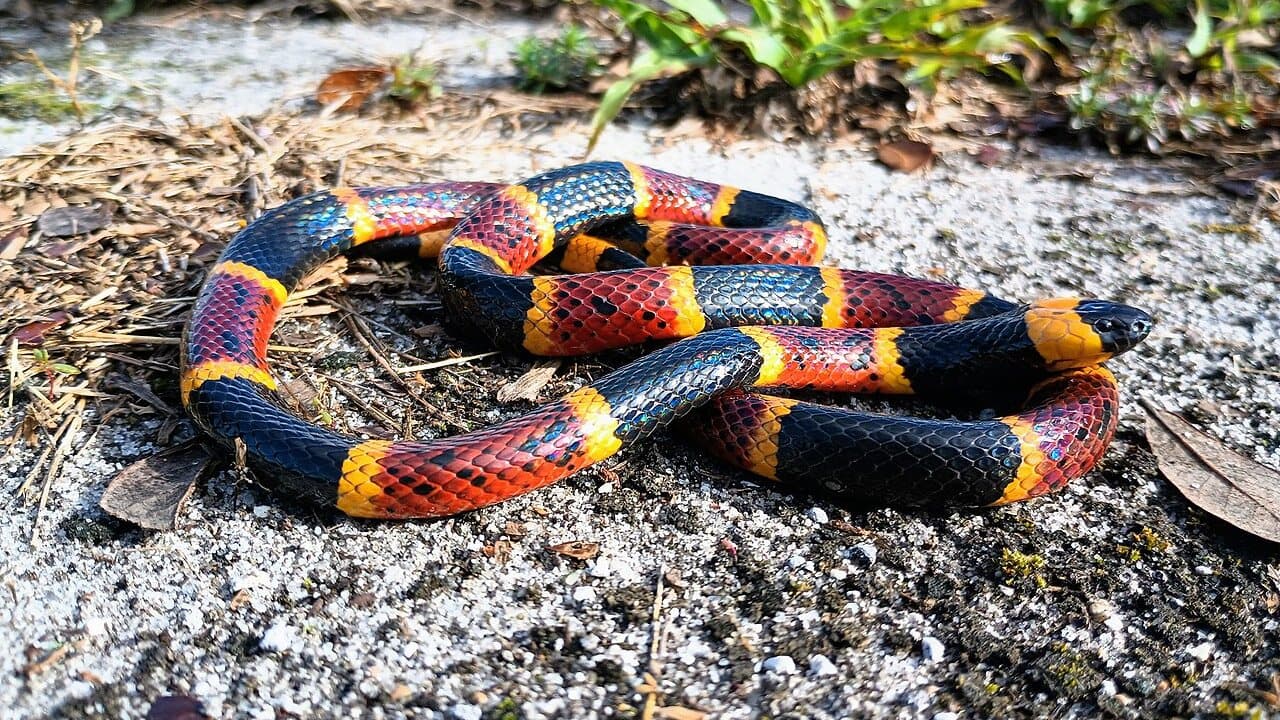
Look where the red bands touch. On a US coral snake, red touches yellow. On the harmless look-alikes, the scarlet kingsnake, milk snakes and the scarlet snake, red touches black. The old rhyme puts it as "red touches yellow, kills a fellow; red touches black, friend of Jack." A second check backs it up: coral snakes have a black snout, while the look-alikes have a red or orange snout. Both checks can be done from a safe distance, and that is the only way they should be done.
Side by side
| Feature | Coral snake (venomous) | Scarlet kingsnake and milk snakes (harmless) |
|---|---|---|
| Band order | Red, yellow, black, yellow, red: red touches yellow | Red, black, yellow, black, red: red touches black |
| Snout | Black, followed by a wide yellow band behind the head | Red or orange; milk snakes may have a pale or blotched snout |
| Head | Small, rounded, about as wide as the neck | Small, slightly wider than the neck |
| Bands around the belly | Rings continue fully around the body | Often continue around the body; scarlet snake belly is plain white |
| Behavior | Secretive, often under leaf litter; may hide its head and wave the tail | Secretive; often found under logs and bark |
| Size | Usually about 2 feet, slender | Scarlet kingsnake usually under 2 feet; milk snakes up to 3 feet or more |
Where the rhyme works and where it does not
The rhyme is reliable for the three native US coral snakes: the eastern coral snake in the Southeast, the Texas coral snake in Texas and Louisiana, and the Sonoran coral snake in southern Arizona and southwestern New Mexico. All have red bands bordered by yellow. South of the border it fails. Many coral snakes in Mexico, Central America and South America have red touching black, two-colored patterns, or no red at all. Very rarely, a US coral snake is aberrant, with missing yellow or unusual coloring. Treat the rhyme as a strong guide in the US and nothing more anywhere else, and never use it as permission to pick up a snake.
The look-alikes
| Snake | Where | How to spot it |
|---|---|---|
| Scarlet kingsnake | Southeast, overlapping with the eastern coral snake | Red snout; red, black and yellow bands with black separating red from yellow |
| Scarlet snake | Southeast | Red snout that is pointed; bands do not continue onto the white belly |
| Milk snakes (eastern, red, Louisiana and others) | Much of the eastern and central US | Red or reddish blotches or bands bordered by black; often found around barns and woodpiles |
| Sonoran mountain kingsnake | Arizona mountains | Red, black and white or cream bands; red touches black |
| Western shovel-nosed snake and ground snakes | Southwest deserts | Small, banded; check band order and snout |
These harmless snakes are thought to benefit from looking like coral snakes, since predators avoid the pattern. Their resemblance is close enough that the band order and snout color are the checks to rely on, not overall impression.
Other red snakes people worry about
Several harmless snakes have red on them without the full band pattern. Corn snakes have red or orange blotches outlined in black on a lighter background, not rings around the body. Red-bellied snakes are small brown snakes with a bright red belly, common under boards in the North. Ring-necked snakes are slate gray with a yellow or orange neck ring and a bright belly. None of them has the red, yellow and black rings of a coral snake, and all of them are harmless. A snake needs complete bands of all three colors, with red touching yellow, to be a US coral snake.
How coral snakes live
Coral snakes spend most of their time hidden under leaf litter, logs, loose soil and debris, and come out mostly in the morning and after rain. They eat other snakes and lizards, including small kingsnakes and garter snakes. When threatened, a coral snake often hides its head under its coils and raises and curls the tail, which makes the tail look like a head. Their fangs are short and fixed in the front of the mouth, and they tend to hold on when they bite rather than strike and release, which is one reason bites so often involve someone handling the snake.
Coral snake bites
Coral snakes rarely bite people; most bites happen when someone picks one up. Their venom is a neurotoxin, different from the venom of rattlesnakes and copperheads. A bite may cause little pain or swelling, and serious symptoms like numbness, drooping eyelids, slurred speech, trouble swallowing and difficulty breathing can be delayed for hours. That delay is what makes them dangerous: anyone bitten by a coral snake, or by an unidentified red, yellow and black snake, should go to a hospital immediately, even if they feel fine. Call 911 or Poison Help at 1-800-222-1222. Keep the person still and calm, remove rings and tight clothing, and do not cut, suck, ice or apply a tourniquet.
Making a yard less snake-friendly
Coral snakes and their look-alikes all want cover: leaf litter, woodpiles, brush, dense ground cover and debris. Keeping grass mowed, moving woodpiles and brush away from the house, clearing junk and boards off the ground, and sealing gaps under doors and around foundations reduce encounters with every kind of snake. Wear gloves when gardening in mulch or leaf litter in coral snake country, and do not reach blindly under logs or into dense plants. If a coral snake turns up indoors or in a garage, keep people and pets away, close the door, and call a wildlife removal service or local animal control.
Kingsnakes are worth keeping
Kingsnakes, including the scarlet kingsnake and the larger eastern and California kingsnakes, eat rodents, lizards and other snakes, including copperheads and rattlesnakes, whose venom they resist. Milk snakes eat mice and are common around old barns, which is where the myth about them drinking milk from cows came from. Killing a banded snake because it might be a coral snake removes a predator that keeps venomous snakes and rodents in check, and most snakebites happen to people trying to kill or handle a snake.
Why so few bites happen
Coral snake bites are uncommon in the US, a small fraction of the venomous bites each year, because the snakes are secretive, small-mouthed and rarely defensive unless grabbed or stepped on barefoot. That rarity is part of the danger: people who would never touch a rattlesnake pick up a pretty banded snake without thinking. The safe habit is simple. Do not handle any red, yellow and black snake, whatever the rhyme says.
Take the photo from a distance
Zoom in from at least six feet and get the head and the first few bands in frame. The snake identifier reads band order and snout color well from a clear photo and separates coral snakes, scarlet kingsnakes, scarlet snakes and milk snakes reliably. It struggles with snakes half hidden in leaf litter, where the bands near the head cannot be seen, and with faded or blurry photos where yellow and white look alike. Never move a snake or lift leaf litter to get a better view. For the other venomous snakes in the US and the rules that do not work for spotting them, see how to tell if a snake is venomous.
Frequently asked questions
Does the rhyme red touches yellow always work?
Within the US it works for the native coral snakes, which always have red bands touching yellow bands. It does not work in Mexico, Central or South America, where some coral snakes have different patterns. Rare aberrant individuals also exist, so treat any red, yellow and black snake with caution.
What does a coral snake bite feel like?
Coral snake bites may cause little pain or swelling at first, and serious symptoms such as numbness, weakness, trouble swallowing or breathing can be delayed by hours. Anyone bitten should go to a hospital immediately, even without symptoms.
Where do coral snakes live in the US?
Eastern coral snakes live in the Southeast from North Carolina through Florida and west to Louisiana. Texas coral snakes live in Texas and Louisiana. Sonoran coral snakes live in southern Arizona and southwestern New Mexico.
Are king snakes good to have around?
Yes. Kingsnakes eat rodents and other snakes, including venomous ones such as copperheads and rattlesnakes, whose venom they resist.