Brown Recluse vs Wolf Spider: Count the Eyes
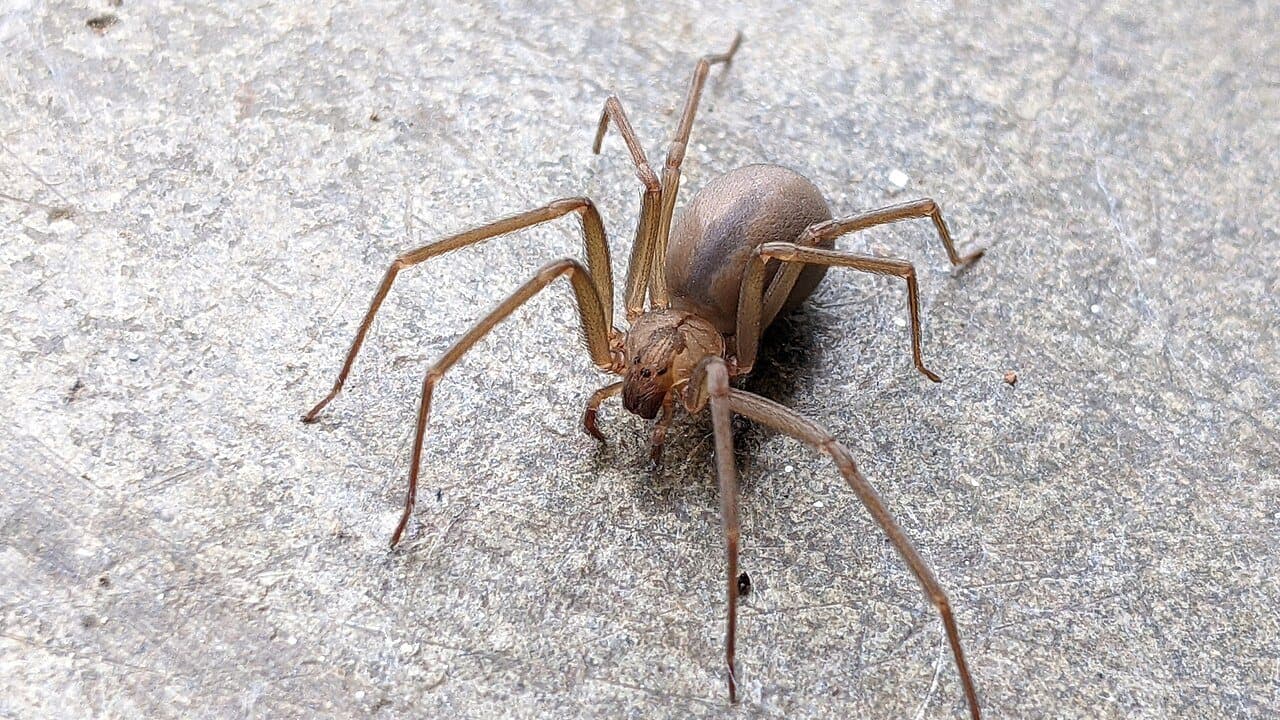
Most spiders reported as a brown recluse are wolf spiders. Both are brown and both turn up indoors, and that is where the resemblance stops. A wolf spider is bigger, hairier, patterned and fast. A brown recluse is small, plain, smooth and has six eyes instead of eight. If you can see the spider clearly, the table below settles it.
Side by side
| Feature | Brown recluse | Wolf spider |
|---|---|---|
| Body length | About 1/4 to 1/2 inch | About 1/2 inch to well over 1 inch |
| Leg span | Roughly a US quarter | Up to 3 or 4 inches in the largest species |
| Color | Even tan to medium brown; legs and abdomen match | Mottled gray, brown and black, usually striped |
| Legs | Long, thin, smooth, no bands, no visible spines | Thick, hairy, often banded, with obvious spines |
| Abdomen | One color, covered in short fine hair | Patterned, hairy |
| Mark on the back | Dark violin on the front body section, neck pointing toward the abdomen | A dark central stripe that people often read as a violin |
| Eyes | 6, in three pairs arranged in a U | 8, in three rows: four small, two large, two medium |
| Behavior | Hides by day; turns up in boxes, shoes and stored clothes | Runs across floors; hunts on the ground |
| Web | Small, irregular, messy web in undisturbed spots | None; it hunts |
| Young | Egg sac hidden in the retreat | Female drags an egg sac from her rear, then carries spiderlings on her back |
| US range | South-central and Midwest only | Every state |
A spider carrying a ball of eggs behind it, or a back covered in babies, is a wolf spider. That one feature ends the question.
The three checks, ranked by how much to trust them
1. Eyes: the check that decides it
A brown recluse has six eyes arranged as three pairs in a shallow U at the front of the head: one pair in the middle, one on each side. A wolf spider has eight, and the two large forward-facing eyes in its middle row are visible without magnification. A zoomed phone photo of the head is enough to count them.
There is a shortcut at night. Shine a flashlight across the floor while holding it near your own eyes. Wolf spider eyes throw back a bright green-white glint from several feet away. Brown recluses do not give the same reflection.
2. Legs and abdomen: smooth and plain vs hairy and patterned
A brown recluse has no bands on its legs, no spines sticking out of them, and no pattern on its abdomen. Any one of those three rules it out. This is the check you can do from across the room, and it eliminates most wolf spiders, grass spiders and fishing spiders on its own.
3. The violin: the one to trust least
The violin is the most famous feature and the least reliable for a nervous person looking at a spider on the ceiling. Plenty of spiders have dark marks on the front body section. Wolf spiders have a central stripe that looks like a violin if you want it to. Young recluses can have a faint violin or barely any. Use it to confirm after the eyes and legs agree, never as the first test.
Where you live matters more than the photo
The brown recluse has a defined range, and it has not moved much in decades. Outside it, the odds of any given brown spider being a recluse are close to zero.
| Region | Brown recluse status |
|---|---|
| Missouri, Kansas, Oklahoma, Arkansas, Tennessee, Kentucky | Core range. Common, and can live indoors in large numbers |
| Southern Illinois, Indiana and Ohio; Alabama, Mississippi, Louisiana; northern Georgia; eastern and central Texas; southern Iowa and Nebraska | Present, at lower density |
| West Coast, Pacific Northwest, Mountain West, Northeast, Florida peninsula | Not established. Isolated finds arrive in moved furniture or boxes |
Arachnologists who have examined spiders mailed in as suspected recluses from outside this range report that almost none were recluses. If you live in Oregon, New York or Florida and found a brown spider, start from the assumption that it is something else and let the eyes prove otherwise.
Where you found it
The spot narrows things down before you look at the spider at all. The two species live completely different lives: one hunts in the open, the other hides in things you have not touched in months.
| Where it was | More likely | Why |
|---|---|---|
| Running across the floor or a wall in the open | Wolf spider | It hunts by chasing prey. Recluses stay near cover |
| Garage floor or near an outside door in late summer and fall | Wolf spider | Adult males wander indoors looking for mates at that time of year |
| Inside a shoe, a stored box, folded clothes, behind a picture frame | Brown recluse, if you are in its range | Undisturbed clutter is exactly where recluses build retreats |
| Stuck in a bathtub or sink | Either | Both fall in at night and cannot climb the smooth sides. Check the eyes and legs |
| Sitting in a web in a corner | Neither | Wolf spiders do not use webs. A spider hanging in a cobweb is usually a house or cellar spider |
| Damp basement near a drain or sump | Wolf or fishing spider | Both like moisture and prey on the insects drawn to it |
Run the identifier on it
Take two photos: one straight down from above showing the whole body and all eight legs, and one close shot of the head. The spider identifier reads leg banding, body shape and abdominal pattern well, and those three features are enough to separate these two in most photos. Where it struggles: dark, blurry shots from under a couch, squashed spiders, and young recluses with no visible violin. The six-eye count needs a sharp close-up; if your photo cannot show the eyes, treat any answer as provisional. A dead spider in a clear jar photographs better than a live one running away.
The look-alikes that are neither
| Spider | Why it gets confused | How to tell |
|---|---|---|
| Grass spider | Brown, fast, striped | Two dark stripes down the front body section, long spinnerets sticking out at the rear, funnel-shaped web in lawns and shrubs |
| Southern house spider (male) | Tan, long-legged, found indoors in the South | No violin; eight eyes clustered on a small bump; the most common recluse false alarm in the Southeast |
| Cellar spider | Thin legs, lives in basements | Tiny body on extremely long legs; vibrates its web rapidly when disturbed |
| Yellow sac spider | Pale, hunts indoors at night | Pale yellow to greenish body, dark mouthparts, eight eyes |
| Fishing spider | Large, brown, hairy | Bigger than most wolf spiders; found near water, docks and damp basements |
What to do with each
Wolf spider. Put a cup over it, slide a card underneath and take it outside. Or leave it. Wolf spiders do not infest houses; the one you found wandered in, usually in fall, and it eats the insects you would rather not have. Spraying the house for one is wasted money.
Brown recluse. In the core range, one usually means more. Sticky traps along walls, behind furniture and in closets are the best way to find out how many. Get boxes off the floor, store clothes and shoes in sealed bins, and shake out anything that has sat in a garage or attic. Sprays do little against a spider that lives inside walls and clutter; traps plus decluttering is what works.
Most recluse bites heal without serious trouble. A minority develop a spreading, darkening wound over several days. See a doctor if a bite blisters, turns dark or keeps growing. Many skin wounds blamed on recluses turn out to be bacterial infections, MRSA included, which is one more reason to have it examined instead of guessing.
For other brown things on your floor, the tiny brown bug guide covers the insects.
Frequently asked questions
Can a brown recluse have stripes on its legs?
No. Brown recluse legs are one even color with no bands, rings or visible spines. A brown spider with striped or banded legs is not a brown recluse.
Is a wolf spider bite dangerous?
Not medically. Wolf spiders bite only when pressed or handled, and the bite feels like a bee sting with local redness and swelling. See a doctor if it shows signs of infection, as with any skin wound.
How big is a brown recluse?
The body is about 1/4 to 1/2 inch long. With legs spread, a grown brown recluse is roughly the size of a US quarter. Anything that covers your palm is not a recluse.
Do brown recluses live in California or the Pacific Northwest?
No established populations. The brown recluse lives in the south-central and Midwest US. California's southeastern desert has a different species, the desert recluse, which stays outdoors in desert habitat and is rarely found in homes.