Carpenter Bee vs Bumble Bee: Bald or Fuzzy
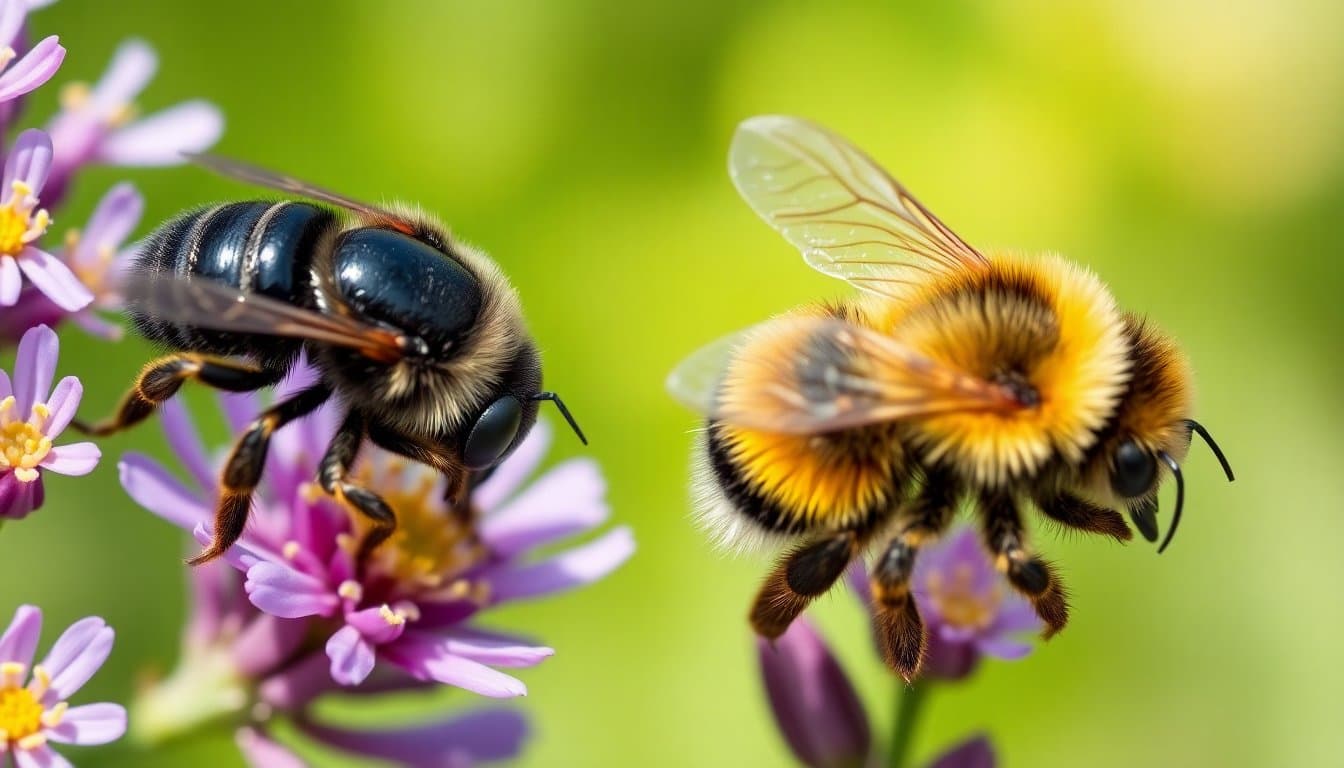
Look at the back half of the bee. If the abdomen is bald, black and shiny like a beetle, it is a carpenter bee. If it is fuzzy all over, with yellow and black hair down to the tip, it is a bumble bee. Both have a hairy yellow thorax and both are big, which is why people mix them up. The abdomen does not lie.
The five-question check
Answer these in order. Most bees are settled by question one; the rest confirm it or cover the cases where you only got a glimpse.
- Is the top of the abdomen shiny or hairy? Shiny and mostly hairless means carpenter bee. Hairy, with bands of yellow, black or orange, means bumble bee. Some bumble bees have a lot of black on the abdomen, but it is still fuzzy black, not glossy.
- Where was it going? Into a round hole in wood: carpenter bee. Into the ground, under a deck board or into a gap in a shed floor: bumble bee.
- Was it hovering at face height near your house? That is a male carpenter bee guarding a territory in spring. Bumble bees fly from flower to flower and do not hold a spot in the air near people.
- Are there pollen clumps on its back legs? Bumble bees carry pollen packed into baskets on the hind legs, so you see solid yellow or orange lumps. Carpenter bees carry pollen loose in leg hair, with no packed clumps.
- Is the thorax evenly fuzzy? On the eastern carpenter bee, the most common one in the US, the yellow thorax has a small bald black spot in the center. Bumble bee thoraxes are fuzzy all the way across.
Side by side
| Carpenter bee | Bumble bee | |
|---|---|---|
| Abdomen | Bald, glossy black | Hairy, banded yellow and black |
| Size | About 3/4 to 1 inch | Workers 1/2 to 3/4 inch; queens close to 1 inch |
| Nest | Tunnels it chews into bare wood | Existing cavities, usually at or below ground level |
| Social life | Solitary; neighbors may share a board | A colony of roughly 50 to 500 with one queen |
| Season | Most visible April to June | Spring to fall, busiest in midsummer |
| Winter | Adults overwinter inside old tunnels | Colony dies; only new queens survive, buried in soil |
| Damages property | Yes, wood | No |
Who stings
The bee most likely to scare you is the one least able to hurt you.
| Bee | Can it sting? | How it behaves |
|---|---|---|
| Male carpenter bee | No. Males have no stinger | Hovers in front of you, dives, chases other bees. All bluff. Males have a pale patch on the face |
| Female carpenter bee | Yes, rarely uses it | Busy drilling and provisioning tunnels; ignores people |
| Bumble bee worker or queen | Yes, and can sting more than once | Calm on flowers; defends the nest if you disturb it or mow over it |
| Male bumble bee | No | Shows up late summer, loafs on flowers |
The practical rule: a big bee buzzing your head by the porch in May is a male carpenter bee and cannot sting. A bumble bee nest you hit with a lawnmower in July is the real sting risk.
Photo it before you decide
If the bee will not sit still long enough to check the abdomen, a photo does the job. Shoot from above or slightly behind while it feeds, so the abdomen faces the camera. The bee identifier separates these two reliably from a sharp top view, because shiny versus fuzzy is exactly the kind of feature a photo captures well. It does poorly with side-on flight shots, motion blur and bees half hidden inside a flower. It also cannot tell you the sex of a carpenter bee unless the face is in frame, and the face is what tells you whether that hovering bee can sting.
The exceptions to the abdomen rule
The shiny-versus-fuzzy test works on the eastern carpenter bee and the common eastern bumble bee, which together cover most of the US. A few insects break it, and they are worth knowing before you trust one glance.
| Insect | Why it confuses | How to tell |
|---|---|---|
| Valley carpenter bee (male), California and the Southwest | Covered in golden fuzz, abdomen included. Looks like a blond bumble bee | Green eyes, uniform golden color with no black bands. Females of the same species are glossy black and follow the normal rule |
| Bumble bee with a mostly black abdomen | Some species have very little yellow on the rear | The black is matte and hairy. A carpenter bee abdomen reflects light |
| Bumble bee mimic flies (robber flies, hover flies) | Fuzzy, yellow and black, bumble bee sized | One pair of wings instead of two, short stubby antennae, huge eyes. They hover and dart like flies |
| Honey bee | Fuzzy thorax, banded abdomen | Much smaller and slimmer, with amber and brown bands and far less hair on the abdomen |
Reading the damage
Carpenter bees leave evidence that bumble bees never do:
- Round holes about 1/2 inch wide, clean-edged as if drilled, on the underside of eaves, fascia, deck rails, porch ceilings and fence tops.
- Coarse sawdust piled directly below a fresh hole.
- Yellow-brown streaks under the entrance from the bees' droppings.
- Bare, unpainted softwood. Cedar, cypress, redwood and pine that is weathered or unfinished gets chosen first. Painted wood is rarely touched.
The tunnel goes in about an inch, then turns and runs along the grain. One season of tunnels is mostly cosmetic. The trouble starts when the same board is reused and extended for years, and when woodpeckers find the larvae inside and tear the wood open to reach them.
To tell an active hole from an old one, look in spring. Fresh pale sawdust below it, bees going in and out during warm afternoons, and a male hovering nearby mean the tunnel is in use. Gray, weathered edges and no sawdust mean it is last year's. Old holes still matter, because returning bees reuse and extend them, so they get plugged either way.
Bumble bee evidence looks different: a steady stream of bees going into one hole in the ground, a gap under a shed, an old bird box, or insulation behind a loose board. No sawdust, no drilled wood.
What to do about each
Carpenter bees: paint the wood. This is the fix. They avoid painted and varnished surfaces, so finishing the exposed boards they like stops new tunnels. Plug existing holes with a glued wood dowel or wood filler, then paint over them. Wooden carpenter bee traps catch some bees, and catching bees is all they do. Paint prevents the next round of tunnels. Do the paint.
Bumble bees: leave them alone. The colony is annual. It peaks in summer and dies off in fall, and the nest is not reused the next year. If it sits away from doors and paths, do nothing; they are some of the most important pollinators in a garden, especially for tomatoes and blueberries. If it is in a doorway or under a step where people will get stung, call a pest professional who relocates bees. Spraying a bumble bee nest in August kills a colony that would have died on its own in October.
For the bee that is neither of these, and the wasps that get mistaken for both, the wasp identifier covers paper wasps and hornets, and the yellow jacket vs bee guide covers the one that crashes picnics.
Frequently asked questions
Do carpenter bees sting?
Males cannot sting at all, even though they are the ones that hover in your face. Females can sting but rarely do unless handled or trapped against skin.
Do bumble bees damage wood?
No. Bumble bees do not bore into wood. They nest in existing cavities: old rodent burrows, under decks and sheds, in compost piles and sometimes in wall insulation.
What do carpenter bee holes look like?
Perfectly round holes about 1/2 inch across, usually on the underside of bare wood: eaves, fascia boards, deck rails, fence tops. Fresh holes have coarse sawdust below them and yellowish stains around the entrance.
Are carpenter bees bad for my house?
One season of tunnels is mostly cosmetic. The damage adds up when the same boards are reused year after year, and woodpeckers tearing into the wood to reach the larvae often do more harm than the bees.