What Arrowhead Is This? Identify Points From a Photo
Ploughed fields, creek gravels and eroding banks turn up worked stone regularly. Our AI reads the shape, the notching and the flaking pattern to suggest a point type and period, names the likely stone, and tells you when a find is a natural break rather than a made object.

- Free to try
- No sign-up
- Results in seconds
Take or upload a photo
AI identifies anything in seconds
1 free identification, no account needed
A stone point is identified by its base first and its outline second. Knappers hafted points in a small number of ways, side notches, corner notches, stems and plain bases, and those choices changed slowly over time and varied by region. That is why a base style plus a location gets you to a type and a period.
Below are the broad point families people most often turn up, and the features that separate them. Photograph both faces with a scale and say where you found it.
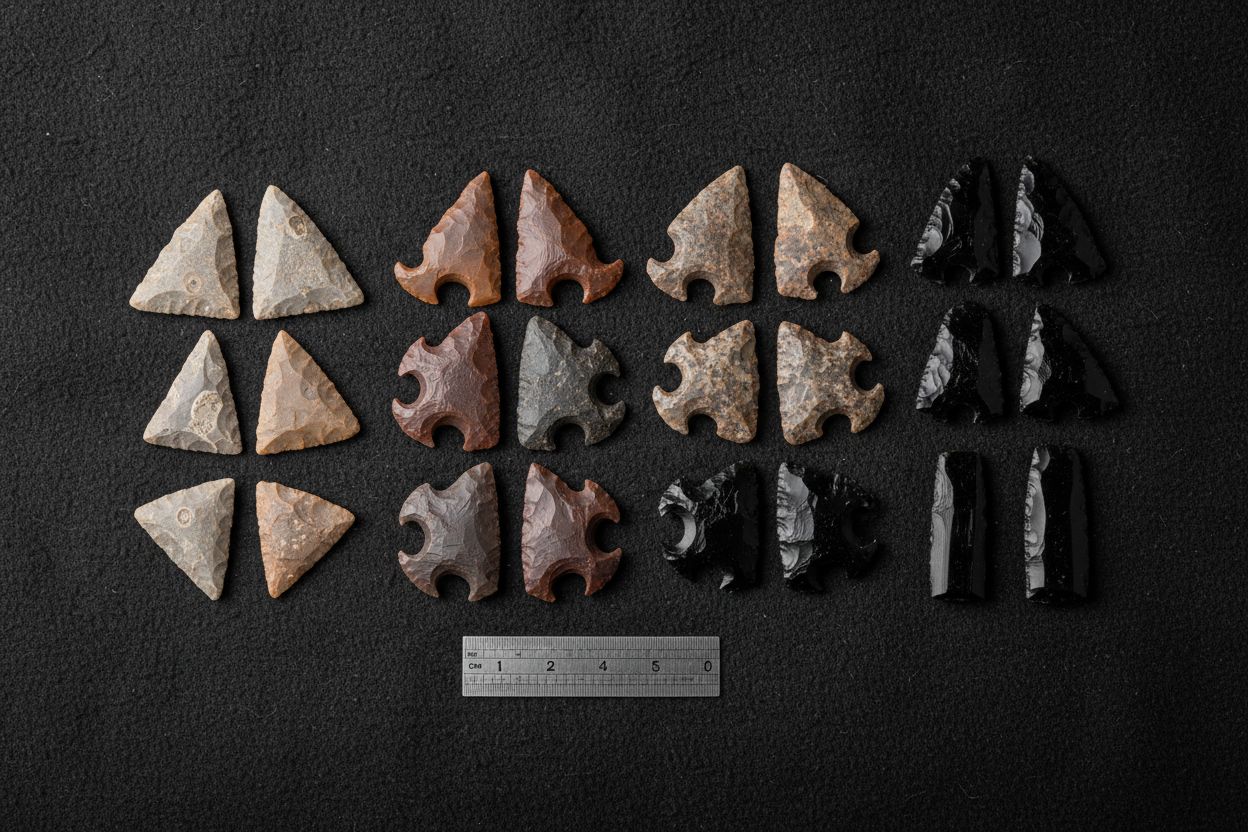
Common types of arrowheads
A quick reference to the ones people ask about most. Not sure which you have? Snap a photo above and let the AI name it.
Triangular points
Small, thin, no notching or minimal notching. Late period and made for the bow, which is why they are so much smaller than earlier work.
Side notched points
Notches cut into the sides just above the base for lashing. A long lived and widespread style with many regional types.
Corner notched points
Notches cut diagonally at the corners, often leaving sharp barbs. Frequently well made and among the most collected forms.
Stemmed points
A narrowed shank at the base that slotted into a shaft. Generally older, larger, and used on darts and spears.
Lanceolate points
Long, leaf-shaped, no notching. Some of the oldest forms in the record and usually the largest.
Scrapers, blades and drills
Not everything worked is a point. Hide scrapers, cutting blades and narrow drills are common and often mistaken for broken arrowheads.
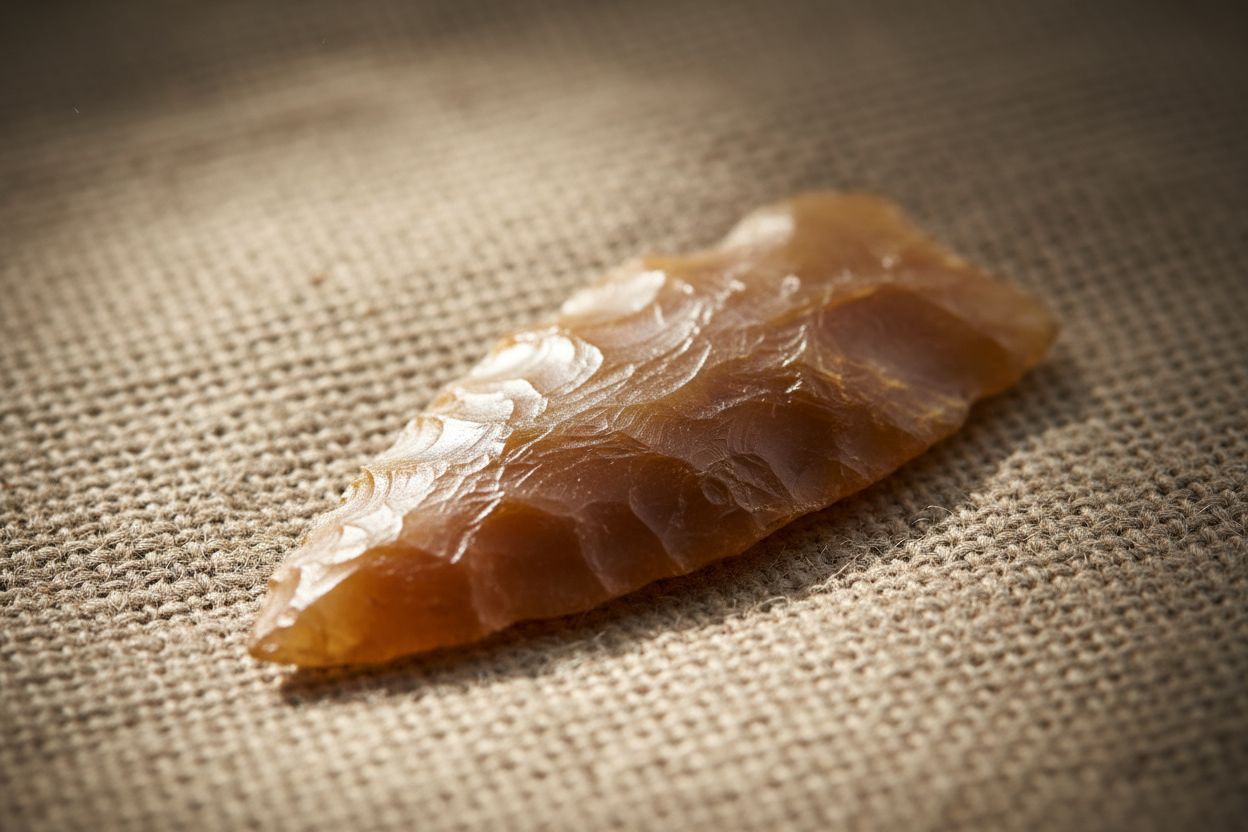
Why identifying arrowheads matters
A stone point is a made object from a person who is otherwise invisible to history, and the type is what places them in time. Point styles changed over thousands of years and were regional, so identifying the form tells you roughly when and where it was made. The identification also tells you whether the find carries any legal reporting duty.
What helps identify arrowheads
Base and Notching
How the point was hafted, side notched, corner notched, stemmed, or plain, is the single most diagnostic feature and the basis of most typologies.
Overall Outline
Triangular, lanceolate, leaf-shaped, or barbed. Shape combined with base style narrows a point to a family of types.
Flaking Pattern
Deliberate flake scars run in patterns and remove material from both faces. Natural breaks are irregular and rarely worked on both sides.
Material
Chert, flint, obsidian, quartzite and jasper each have a look and each has a source region, which helps place the find geographically.
Size and Thickness
Large heavy points were spear and dart tips. Small thin ones came with the bow and arrow, which arrived much later.
Worked point or natural break?
Stone fractures on its own all the time, and frost, ploughs and river tumbling all make sharp pointed pieces. The difference is intent. A worked point is thinned from both faces, has flake scars that run in a pattern rather than at random, and is symmetrical about its long axis. A natural break is thick in the middle, worked on one face if at all, and asymmetrical. Hold it up and turn it. Deliberate work is obvious once you know to look for it on both sides.
Photo tips for the best identification
- 1Photograph both faces and the edge on a plain background, with a ruler or coin alongside. Type identification depends on measurements.
- 2Use side lighting so the flake scars cast shadows. Flat overhead light hides the workmanship entirely.
- 3Say what region you found it in. Point typologies are strongly regional and location narrows the possibilities enormously.
- 4Do not scrub the point. Soil residue and patina both help with age, and cleaning can scratch the surface permanently.
Frequently asked questions
Is this a real arrowhead or just a broken rock?
Worked points show flake scars on both faces, a symmetrical outline, and edges that were deliberately thinned. Natural breaks are irregular and worked on one face at most. Photograph both sides in side light and the AI will tell you which it sees.
How old is my arrowhead?
Age comes from the type. Large stemmed and lanceolate points are generally much older, while small thin triangular points are late and belong to the bow and arrow period. The AI gives a likely type and the period range that goes with it.
What stone is it made from?
Most points are chert or flint. Obsidian is glassy and usually black. Quartzite is grainy and sparkles. The AI names the likely material from colour and texture, and material often points to a source region.
Can I legally keep an arrowhead I found?
On private land with permission, usually yes in most places. On public, federal or protected land it is frequently illegal to collect artefacts at all, and penalties can be serious. Never dig, and check your local law before collecting anything.
Identify arrowheads on the go
Get the What Is This app for unlimited scans, offline mode, and a history that syncs.