Possum vs Opossum: Same Animal or Not?
In North America, a possum and an opossum are the same animal: the Virginia opossum, the only marsupial native to the US and Canada. "Possum" is just the everyday short form, the way "coon" is for raccoon. The confusion comes from Australia, where a different group of marsupials is officially called possums. If the animal is in your yard, garage or headlights in the US, it is an opossum, whatever you call it.
Where the two names come from
The word opossum comes from a Powhatan word recorded by English colonists in Virginia in the early 1600s, written down in spellings like "opassom." Over time Americans dropped the first syllable in speech. When Europeans later reached Australia and found tree-dwelling marsupials that reminded them of the American animal, they called those possums too. The two groups are only distantly related, and they look quite different.
| Virginia opossum (Americas) | Possums (Australia and nearby) | |
|---|---|---|
| Where | US, southern Canada, Mexico, Central America | Australia, New Guinea, nearby islands; introduced to New Zealand |
| Face | Long, pointed, white, with a pink nose | Shorter, rounder face, often with large eyes |
| Tail | Long, naked, scaly, rat-like | Furry and often bushy, like the common brushtail possum |
| Ears | Thin, hairless, dark | Furred |
| Size | About house-cat size, 4 to 14 lb | From mouse-sized to cat-sized depending on species |
| Teeth | 50, more than any other North American land mammal | Fewer |
So the honest answer to "possum or opossum?" depends on where you live. In the US, use either. In Australia, an opossum is something you would only see in a zoo.
How to recognize an opossum
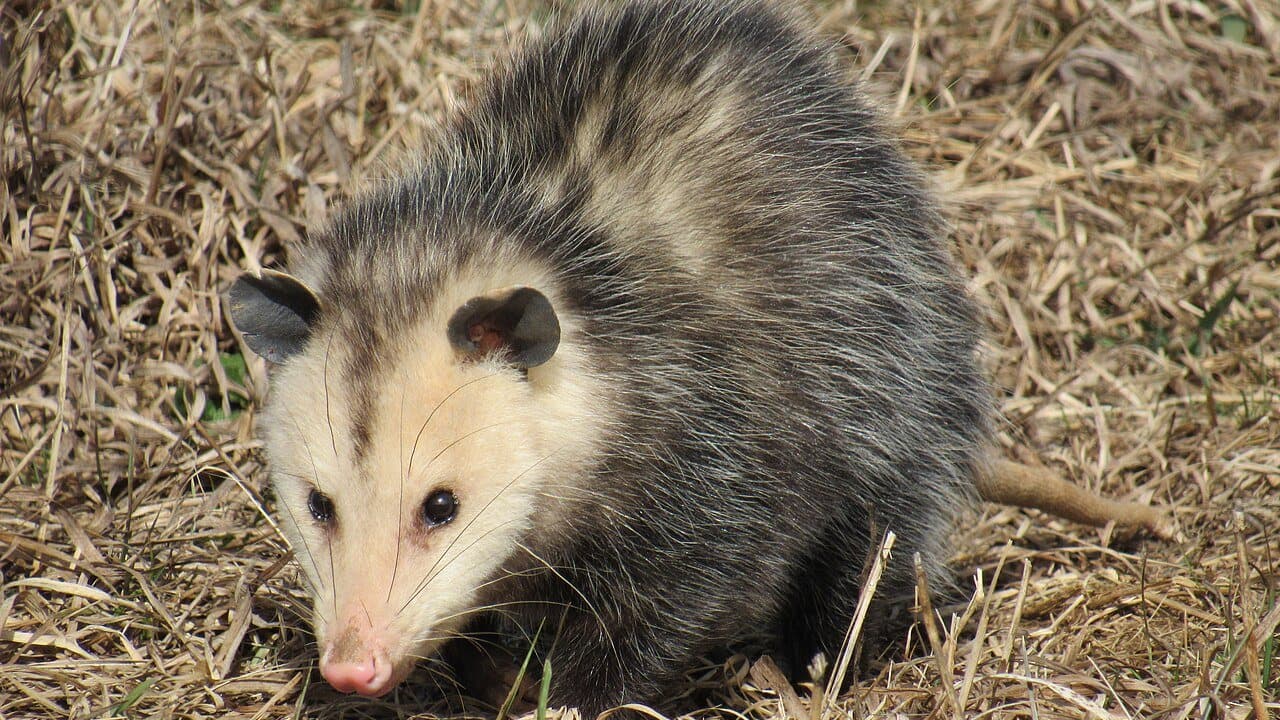
- White face, pink nose, beady black eyes and thin dark ears that look like leather.
- Grizzled gray body with long, coarse guard hairs over a woolly undercoat. Some are darker, nearly black.
- Long, naked tail, pale and scaly, often darker at the base. They can wrap it around branches but adults cannot hang from it for long.
- Hand-like feet. The hind foot has an opposable thumb without a claw, which leaves a distinctive track.
- Slow, waddling walk. Opossums are not fast and do not try to be.
What else it could be
| Animal | Why it gets confused | How to tell |
|---|---|---|
| Norway rat | Naked tail, gray, seen at night by trash | Far smaller (under a pound), brown, no white face. A big opossum is the size of a cat |
| Raccoon | Similar size, nighttime, trash cans | Black mask across the eyes and a thick ringed, furry tail |
| Groundhog | Gray-brown, chunky, in yards | Short furry tail, dark face, active by day, lives in burrows |
| Skunk | Black and white, nocturnal | Black with white stripes and a bushy tail |
| Feral or outdoor cat | Similar size in headlights | Furry tail, cat face and movement |
In a trail camera photo at night, eyeshine and a pale face with a long naked tail behind it is an opossum. Raccoons show the mask and ringed tail even in infrared.
Behavior worth knowing
Playing dead is real and involuntary. A badly frightened opossum can collapse into a coma-like state, lying on its side with its mouth open and teeth showing, drooling and giving off a foul smell from its anal glands. It is not a choice; it is a stress response, and it can last from minutes to a few hours. Leave it and it will get up and wander off.
The hissing display is mostly bluff. Before that, an opossum often opens its mouth wide to show all 50 teeth and hisses. It looks fierce. It is a bluff aimed at getting you to back away, and it usually works.
They are short-lived nomads. Opossums do not hold permanent territories. They move through an area, use a den under a deck or in a woodpile for a few days, then move on. Most live only two to four years in the wild.
They carry babies twice. Newborns are the size of a honeybee and crawl into the mother's pouch. When they outgrow it, around two to three months, they ride on her back, which is the scene that makes people take photos.
Opossums in winter
Opossums do not hibernate, and their thin, naked ears and tails are poorly suited to cold. In the northern part of their range, which has been creeping north into New England, the upper Midwest and southern Canada over the past century, many opossums lose the tips of their ears and tails to frostbite. A ragged-eared opossum in February is common in those areas, not a sign of disease. In very cold spells they stay in dens for days and come out on milder nights, which is when people see them raiding compost and pet bowls.
Opossums and pets
Opossums avoid fights. Faced with a dog they hiss, then often collapse and play dead; faced with a cat they usually share the porch awkwardly and leave. The real problem is food: pet food left outside, birdseed on the ground and open garbage bring them back night after night. Bring bowls in at dusk and the visits usually stop.
The tick myth
You will see the claim that a single opossum eats around 5,000 ticks a season. It came from an estimate built on a small number of captive animals offered ticks in a lab. Later research that examined the stomach contents of wild opossums found ticks rarely. Opossums are useful anyway: they eat insects, snails, slugs, carrion, fallen fruit and the occasional mouse, and they clean up a lot of what other animals leave behind. They are just not a tick vacuum, and keeping one around will not solve a tick problem.
Good or bad for the garden?
Mostly good. Opossums eat slugs, snails, beetles, grubs, crickets, mice and fallen fruit, and they clean up carrion and spilled birdseed. They will also help themselves to ripe strawberries, tomatoes and melons, and they dig shallow holes in lawns while hunting grubs. Netting over ripening fruit and picking it promptly handles most of that. Compared with raccoons, which tear into trash and gardens with real determination, opossums are minor nuisances.
Tracks and photos
Opossum tracks are easy to recognize once you know them: the front foot looks like a small star-shaped hand with five spread toes, and the hind foot has a thumb that sticks out sideways like a human hand. The animal track identifier reads that pattern from a clear photo in mud or snow; put a coin next to the print for scale. For photos of the animal itself, a side view showing the face and tail is all an identifier needs. Infrared trail camera images work too, since the white face and naked tail show up well even in black and white.
If one is living under your deck
- Wait. Most opossums move on within days. Making the spot less comfortable, with light and noise at night, speeds that up.
- Remove what attracts them: pet food left outside, open trash, fallen fruit and easy access to compost.
- Seal the space under decks and sheds with hardware cloth buried a few inches into the ground, after making sure no animal is inside. A one-way exclusion door works if one is denning there.
- Found a young one alone? If it is smaller than about 7 inches long not counting the tail, it is too young to survive alone; call a licensed wildlife rehabilitator. Larger juveniles are independent and should be left alone.
For another animal people misname in the yard, the chipmunk vs squirrel guide covers the striped ones.
Frequently asked questions
Is a possum the same as an opossum?
In North America, yes. People say possum as a short form of opossum, and both refer to the Virginia opossum. Biologists use possum for a different group of marsupials that live in Australia and nearby islands.
Do opossums really eat thousands of ticks?
Probably not. The widely shared figure of about 5,000 ticks per season came from an estimate based on captive animals. Later studies of wild opossums found few ticks in their stomachs. They do eat insects, snails, carrion and rodents.
Do opossums carry rabies?
Rabies is rare in opossums, but not impossible. Any wild mammal acting strangely should be avoided, and any bite should be washed and checked by a doctor.
Why do opossums play dead?
When badly frightened, an opossum can fall into an involuntary, coma-like state: it lies on its side with its mouth open, drools and releases a foul smell. It can last minutes to hours. Leave it alone and it will get up and leave.