Coyote vs Wolf: Size, Snout, Ears and Tracks
A wolf is about twice the weight of a coyote, with a broad blocky muzzle, short rounded ears and paws that leave 4 to 5 inch tracks. A coyote is lean and fox-like, with a narrow pointed snout, tall pointed ears and tracks about half that size. In most of the US the question answers itself before you look at the animal: coyotes live everywhere, and wolves live in a handful of regions. Start with the numbers, then check the map.
By the numbers
| Feature | Coyote | Gray wolf |
|---|---|---|
| Weight | 20 to 50 lb; eastern coyotes at the top of that range | 60 to 120 lb, large males more |
| Shoulder height | About 21 to 24 inches | About 26 to 32 inches |
| Overall build | Slim, light, long-legged; looks like a mid-sized dog | Massive chest, long legs, looks like a very large dog |
| Muzzle | Narrow and pointed | Broad and blocky |
| Ears | Tall and pointed, large for the head | Shorter and more rounded, small for the head |
| Tail when running | Held low, pointing down | Held straight out behind |
| Coat | Grizzled gray and tan, reddish on legs and ears | Gray, black, white or mixed |
| Track length | About 2 1/2 to 3 inches | About 4 to 5 inches |
| Voice | Yips, barks and short wavering howls, often in a chorus | Long, deep, steady howls |
| Groups | Alone, in pairs or small family groups | Packs |
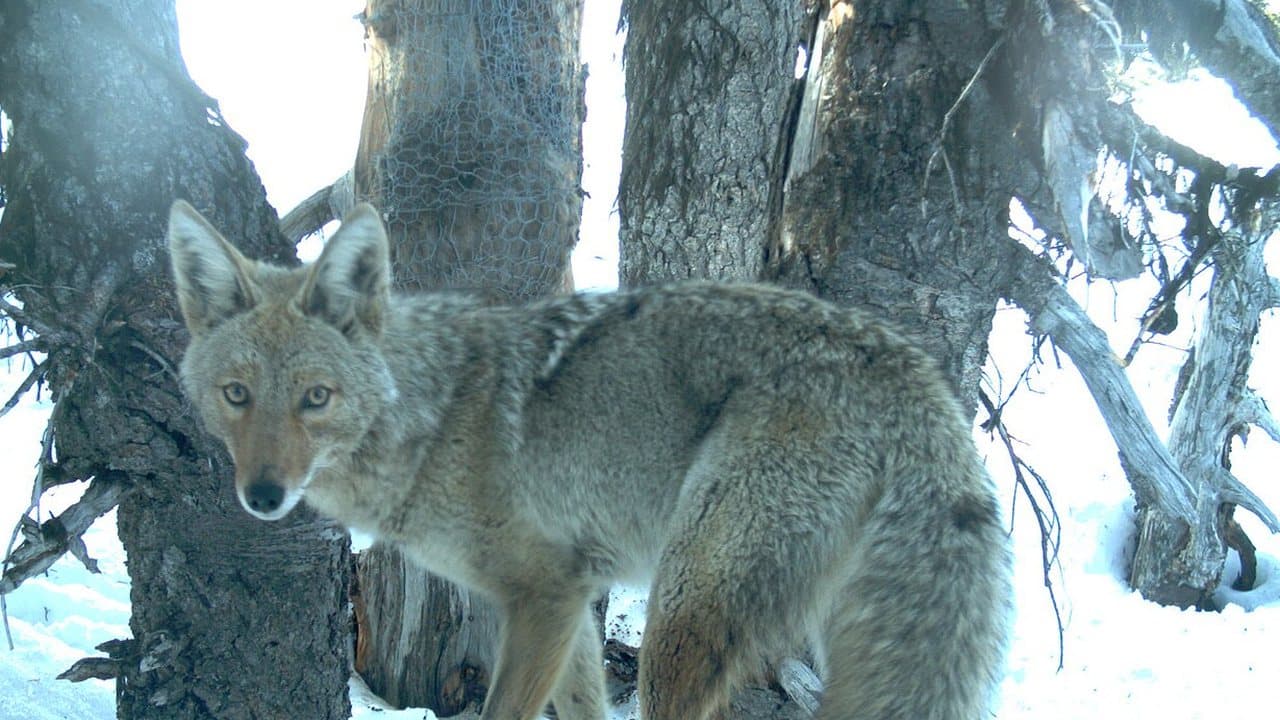
The face is the fastest check. Picture a coyote's face as a fox's face scaled up, and a wolf's face as a German shepherd's head on a heavier frame. Big ears on a narrow face means coyote.
Where wolves actually live
| Region | Wolves present |
|---|---|
| Montana, Idaho, Wyoming | Gray wolves, well established |
| Minnesota, Wisconsin, Michigan's Upper Peninsula | Gray wolves, well established |
| Washington, Oregon | Gray wolves, growing populations |
| Northern California | A few packs |
| Colorado | Reintroduced starting in late 2023 |
| Arizona, New Mexico | Mexican gray wolves, a smaller subspecies of about 50 to 80 lb |
| Eastern North Carolina | A small wild population of red wolves |
| Alaska | Gray wolves statewide |
| Everywhere else in the lower 48 | No established wolves; occasional dispersing individuals |
Coyotes live in every one of those places too, plus every other state in the lower 48, including big cities like Chicago, Los Angeles and New York. If you are in Ohio, Georgia or Texas and saw a wild canine, it was a coyote, or a dog.
The eastern coyote problem
Coyotes in the Northeast and eastern Canada are larger than western coyotes, often 35 to 45 pounds and sometimes more, with broader heads and thicker coats. They carry some wolf ancestry, which is why they are sometimes called coywolves. They are still coyotes, and they are the main reason people in New England report wolves. Use the ears, muzzle and tracks; a big eastern coyote still has a coyote's face and tracks under 3 1/2 inches.
And the fox
Foxes are the third canine people mix in, usually with coyotes. They are much smaller than either, and the differences are easy once you know them.
| Feature | Red fox | Gray fox | Coyote |
|---|---|---|---|
| Weight | 8 to 15 lb | 7 to 13 lb | 20 to 50 lb |
| Color | Rusty orange with black legs | Grizzled gray with rusty sides | Grizzled gray and tan |
| Tail | Very bushy, white tip | Black stripe on top, black tip | Bushy, black tip, held low |
| Build | Cat-sized body on thin legs | Compact, short legs; climbs trees | Dog-sized, long legs |
| Track | About 2 inches, often blurred by fur | About 1 1/2 inches, rounder | About 2 1/2 to 3 inches |
Size is the clincher. A fox standing in a yard looks like a large house cat on stilts. A coyote looks like a lean medium dog. Mange complicates this: a coyote with mange loses fur and can look thin and fox-like, and a mangy fox can look like a small coyote, so look at the tail tip and the legs.
The dog problem
German shepherds, huskies, malamutes and shepherd mixes cause more wolf reports than coyotes do. Clues that you are looking at a dog: a curled or upward tail, a collar, a broad chest on short legs, a muzzle shorter than a wolf's, and behavior that does not avoid people. Dog tracks also tend to splay and show claws prominently, and a dog trots in a wandering line where wild canines move in straight, efficient lines.
Hearing them at night
Most people hear coyotes long before they see one. A coyote family calling together produces a burst of yips, barks and short wavering howls that sounds like a dozen animals; it is often two or three. Wolves howl in long, low, steady notes that can carry for miles, and a pack chorus sounds deeper and more harmonized. In most of the country, that frantic yipping chorus at night is coyotes, and it often follows a siren, which sets them off.
Tracks
Tracks are often the only evidence, and they are more objective than a glimpse at dusk. Measure the length of a single print without the claws:
- Under 3 inches: coyote, fox or small dog.
- About 3 to 3 3/4 inches: large coyote or medium to large dog.
- 4 inches or more: wolf or large dog.
Measure several prints, not one. A print in soft mud or melting snow spreads and looks bigger than the foot that made it, so take the smallest clear print as the best estimate. The stride also helps: wolves cover more ground per step, with walking strides commonly over 2 feet between prints from the same foot side, where coyote strides are noticeably shorter. Front feet are a little larger than hind feet in both, so a trail mixes two sizes.
Wild canine tracks are oval with the two outer toes tucked in, leaving an X-shaped space between the pads. They follow a straight line, often with the hind foot landing in the front foot's print.
Using a photo or a track photo
Trail camera shots, phone photos at dusk and photos of tracks in snow or mud are the usual evidence. The animal track identifier reads print shape, toe arrangement and gait pattern; put a coin, pen or ruler next to the print so it can judge size, since size is what separates a coyote from a wolf. For photos of the animal itself, a side view showing the head and ears is what decides it. Grainy night shots from trail cameras and animals far across a field are where photo identification gets unreliable; one clear track with a scale reference often beats them.
Why the answer matters
- Legal. Gray wolves are a protected species in much of the lower 48. Shooting a wolf believed to be a coyote can bring federal charges, which is why hunter education courses spend time on this exact comparison.
- Pets. Coyotes take cats and small dogs, especially at dawn and dusk. Keep small pets inside at night and on a leash on trails.
- Safety. Both rarely threaten people. Coyotes that approach people usually have been fed. Make yourself big, make noise, and report bold coyotes to local wildlife officials.
Found droppings instead of tracks? The animal scat identifier covers coyote, fox and dog scat.
Frequently asked questions
How big is a coyote compared to a wolf?
A typical coyote weighs 20 to 50 pounds and stands about 2 feet at the shoulder. A gray wolf weighs roughly 60 to 120 pounds and stands about 26 to 32 inches. Wolves are about twice as heavy.
Are there wolves in my state?
Gray wolves live in the Northern Rockies, the western Great Lakes, Washington and Oregon, parts of northern California, and in Colorado after a 2023 reintroduction. Mexican wolves live in Arizona and New Mexico. Red wolves survive in the wild only in eastern North Carolina. Coyotes live in every state of the lower 48.
Are coyotes dangerous to people?
Attacks on people are rare. The real risk is to small pets and to coyotes that have been fed and lost their fear of people. Keep pets inside at night and never feed coyotes.
What is a coywolf?
It is a popular name for the eastern coyote, which carries some wolf ancestry and is larger than western coyotes. It is still a coyote, not a separate species.