Chipmunk vs Squirrel: Check for Face Stripes
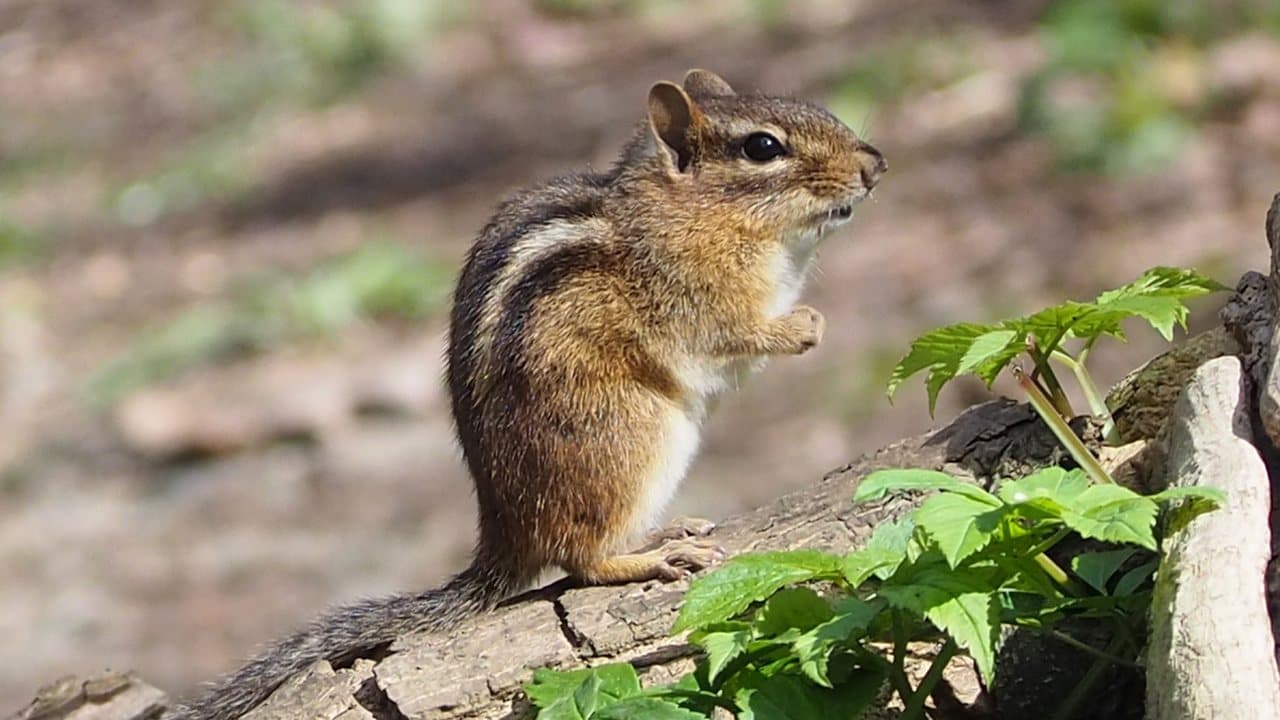
Look at the face. A chipmunk has stripes on its face, running through and around the eye, as well as down its back. A squirrel has no face stripes. That rule handles the obvious case, a small striped animal versus a big gray squirrel, and it also handles the tricky one: striped ground squirrels that people call chipmunks, which have body stripes but plain faces.
Side by side
| Feature | Eastern chipmunk | Gray squirrel |
|---|---|---|
| Length | About 9 to 11 inches including tail | About 16 to 20 inches including tail |
| Weight | About 3 to 5 ounces | About 1 to 1 1/2 pounds |
| Stripes | Dark and light stripes on the face and down the back, ending at a reddish rump | None |
| Color | Reddish brown | Gray, sometimes brown or black |
| Tail | Thinner, furry, held straight up when running | Large, very bushy, often curled over the back |
| Cheeks | Stretchy cheek pouches; often seen stuffed with seeds | No pouches; carries food in the mouth |
| Lives | On the ground; burrows | In trees; leaf nests and tree cavities |
| Voice | High "chip" calls, repeated; low "chuck" calls | Raspy barks, chatters and squeals |
The size difference is large enough that you rarely need the stripes. A chipmunk fits in your palm. A gray squirrel is about four times its weight.
The striped look-alikes
| Animal | Where | How to tell it from a chipmunk |
|---|---|---|
| Thirteen-lined ground squirrel | Lawns, golf courses and prairies in the central US | Alternating stripes and rows of spots down the body; no stripes on the face; longer, slimmer body |
| Golden-mantled ground squirrel | Mountains and forests of the West | Stripes along the sides but not on the face; coppery head; larger and chunkier |
| Red squirrel | Northern and mountain forests | Small, reddish, a white eye ring and no stripes; loud chattering from trees |
| Least chipmunk and other western chipmunks | The West and northern forests | Real chipmunks: stripes on the face, smaller than the eastern chipmunk |
| Flying squirrel | Forests; mostly seen at night at feeders | Large dark eyes, a loose fold of skin between front and back legs, flat tail |
The golden-mantled ground squirrel is the classic case: hikers in the western mountains photograph one at a trailhead and call it a chipmunk. It is bigger, and its face has no stripes. Western chipmunks at the same trailhead do.
The other tree squirrels
| Squirrel | Size | Look | Where |
|---|---|---|---|
| Gray squirrel | About 1 to 1 1/2 lb | Gray with a white belly; black forms common in some cities | Eastern US and many western cities |
| Fox squirrel | About 1 to 3 lb, the largest tree squirrel | Rusty orange-brown with an orange belly | Central and eastern US, open woods and towns |
| Red squirrel | About 7 to 9 oz | Small, reddish, white eye ring, white belly | Northern and mountain conifer forests |
| Western gray squirrel | About 1 to 2 lb | Silvery gray, very bushy tail | Pacific states |
Red squirrels leave piles of stripped cone scales, called middens, at the base of trees, and they scold loudly from branches. None of these have stripes, so none of them are chipmunks.
A year in a chipmunk's life
| Season | What they are doing |
|---|---|
| Early spring | Emerge from burrows; mating; loud chip calls |
| Late spring and summer | Young appear above ground; foraging for seeds, berries, insects |
| Fall | Busy hoarding seeds and nuts in cheek pouches; the most visible season |
| Winter | Mostly underground, waking periodically to eat stored food |
Behavior gives them away
Chipmunks stay on or near the ground. They dash across lawns and patios with their tails straight up, dive into small holes, and climb only short distances into shrubs and low trees. In late summer and fall they spend most of their time gathering seeds and nuts into their cheek pouches and carrying them to underground storage. Tree squirrels spend their lives up in the canopy, leap between branches, bury nuts one at a time in scattered spots, and build bulky leaf nests high in trees. A small animal disappearing into a hole in the ground is a chipmunk or ground squirrel. A larger one racing up a trunk is a tree squirrel.
Burrows and nests
A chipmunk burrow entrance is a clean, round hole about 2 inches across with no pile of dirt around it; the chipmunk carries the soil away and hides it. Look along foundations, under steps, beside walls and in flower beds. Ground squirrel holes are similar in size but often in open lawns. Tree squirrels do not dig burrows; their nests are football-sized clumps of leaves high in trees, and they sometimes move into attics through gaps under the roofline.
Damage and what to do
- Chipmunks can undermine patios, stairs and retaining walls with their tunnels, and dig up bulbs and seedlings. Plant bulbs under wire mesh or with gravel, keep stacked wood and rock piles away from the house, and move bird feeders away from the foundation, since spilled seed is their main attraction. L-shaped wire mesh along a foundation or wall discourages burrowing. Live trapping is legal in many areas but new chipmunks often move in.
- Tree squirrels raid bird feeders, chew wiring and wood, and nest in attics. Squirrel baffles on feeder poles, trimming branches back from the roof and sealing gaps under the eaves are the useful steps. If squirrels are already in the attic, a one-way exclusion door lets them out without letting them back in; check for young first in spring.
- Ground squirrels dig in lawns and gardens; fencing that extends below ground and removing cover help.
Do not hand-feed chipmunks or squirrels. Tame animals bite, and feeding draws more of them to your foundation and attic. Small rodents rarely carry rabies, but any bite should be washed well and checked by a doctor.
Chipmunk or rat?
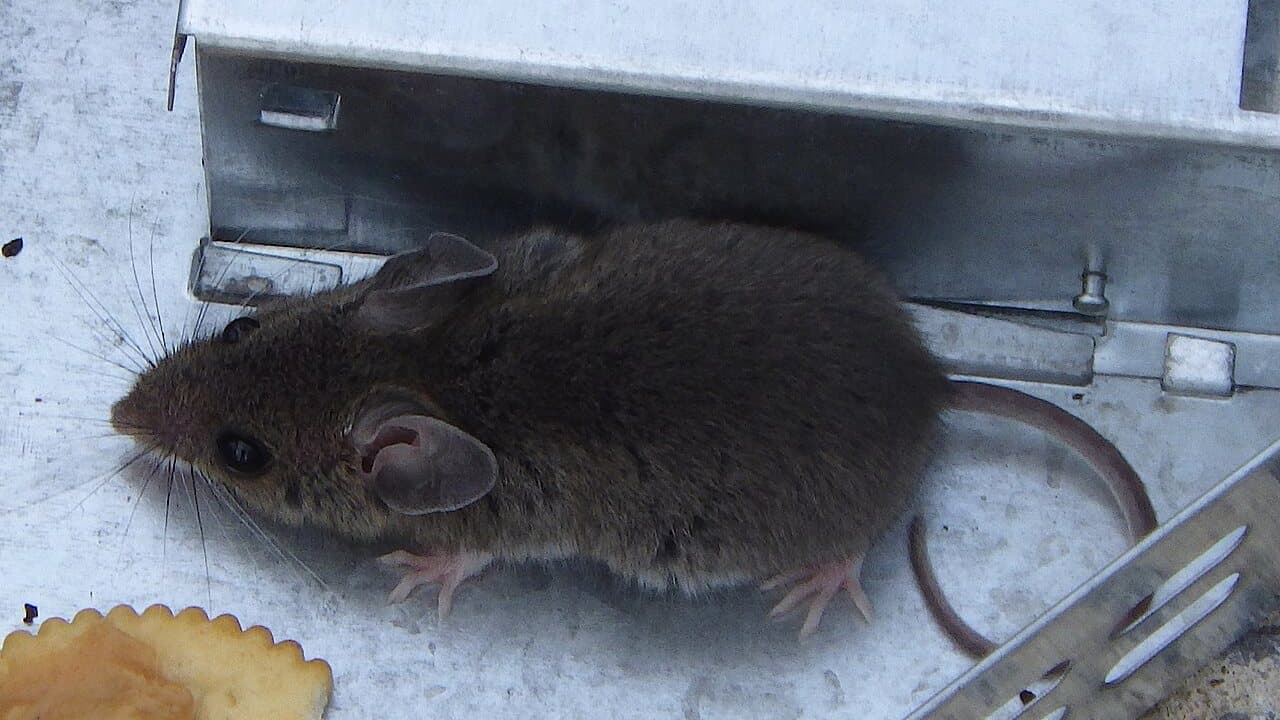
A brown animal running along a fence or foundation is sometimes a rat. Norway rats are bigger, about 7 to 10 inches in body plus a long, naked, scaly tail, with no stripes, and they are most active at night. Their burrows usually have a fan of loose dirt at the entrance, and they leave dark droppings about 3/4 inch long along their routes. A small striped animal out in daylight with a furry tail held straight up is a chipmunk. That difference matters, because rats near a house are a sanitation problem worth acting on quickly, and chipmunks are not.
When one gets inside
Chipmunks occasionally wander into garages, sheds and houses through open doors or gaps. Close interior doors, open an outside door, and give it a quiet path out; it wants to leave as much as you want it gone. A live trap baited with peanut butter or sunflower seeds works if it hides. Squirrels in living spaces are handled the same way. Animals in the attic or walls are a different job, covered above.
Photos and tracks
A side view that shows the face and the back is all it takes. The animal track identifier handles footprints and burrow photos as well: chipmunk and squirrel tracks both show four toes on the front foot and five on the back, with the hind feet landing ahead of the front in a bounding pattern, but squirrel prints are roughly twice the size. Include a coin for scale. Blurry shots of an animal in mid-dash are the hardest case; a few seconds of patience usually gets you one sitting still on a log or wall.
For the other small animals that dig in the yard, see the mole vs vole guide.
Frequently asked questions
Is a chipmunk a type of squirrel?
Yes. Chipmunks belong to the squirrel family, along with tree squirrels, ground squirrels, prairie dogs and groundhogs. In everyday use, squirrel usually means the bigger, bushy-tailed tree squirrels.
How do I tell a chipmunk from a striped ground squirrel?
Look at the face. Chipmunks have stripes running through and around the eye. Ground squirrels like the thirteen-lined or golden-mantled ground squirrel have stripes on the body but not on the face.
Do chipmunks hibernate?
Chipmunks spend much of the winter in their burrows, sleeping for long stretches and waking to eat from food they stored in the fall. They may come out on mild winter days. Tree squirrels stay active all winter.
Are chipmunks bad for my yard?
Usually they are a minor nuisance. Their burrows can undermine patios, steps and retaining walls, and they dig up bulbs and eat seeds. A few chipmunks in a yard are normal and rarely cause real damage.