Hawk vs Eagle: How to Tell Which One You Saw
Most large birds of prey people report as eagles are red-tailed hawks or turkey vultures. Real eagles are much bigger than either: a bald eagle has a wingspan of 6 to 7 feet, roughly half again a red-tailed hawk's, and soars on flat, plank-like wings with a head that sticks far out in front. Below is how to separate them in the air and on a perch, plus the four confusions that cause most of the mistakes.
Size, shape and flight
| Feature | Bald eagle | Red-tailed hawk |
|---|---|---|
| Wingspan | About 6 to 7 1/2 feet | About 4 feet |
| Weight | 6 to 14 lb | 2 to 3 lb |
| Height perched | About 3 feet | About 1 1/2 to 2 feet |
| Wings in a soar | Long, broad and flat, like a plank or a door | Broad and rounded, held flat or in a slight lift |
| Head in flight | Large, sticks out far ahead of the wings, about half the length of the tail or more | Short; barely projects past the wings |
| Tail | Wedge-shaped, white on adults | Short and fanned, rusty red on top in adults |
| Wingbeats | Slow, deep, heavy | Quicker |
| Where | Near large rivers, lakes, coasts and reservoirs; winter gatherings at open water | Highways, fields, suburbs, parks; perched on light poles and fence posts |
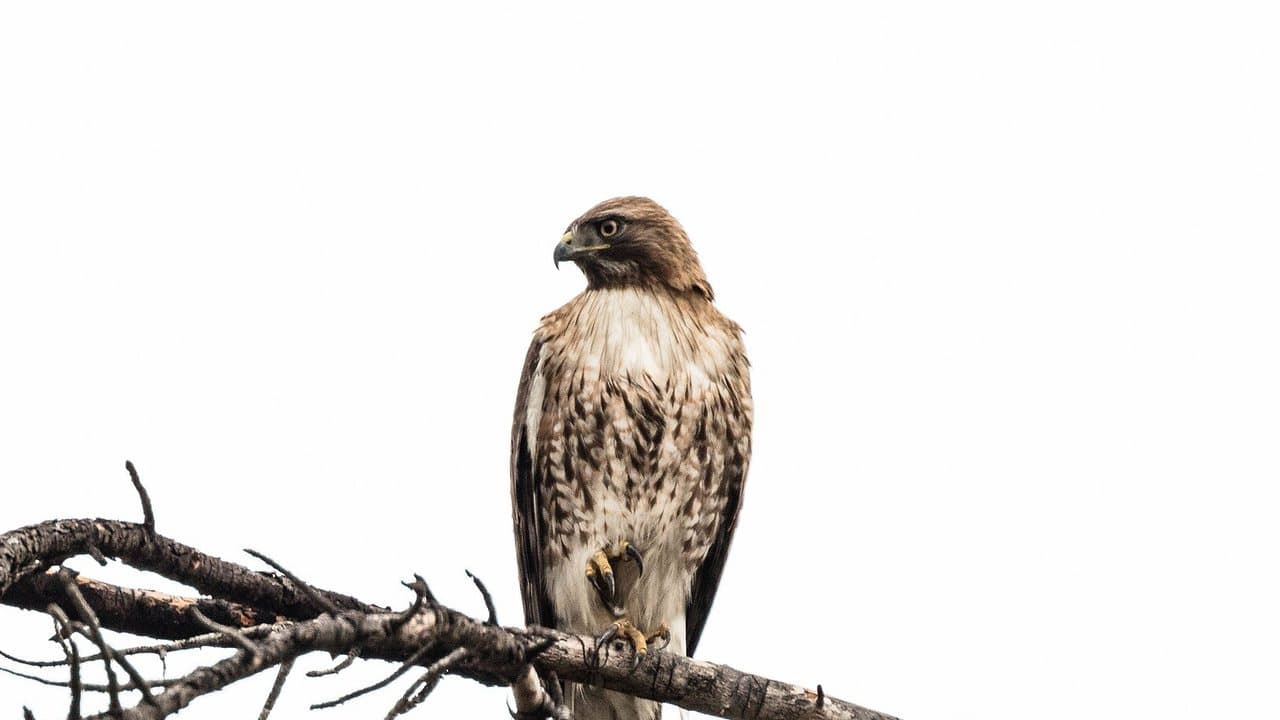
A useful rule: a large bird of prey sitting on a highway light pole or fence post is almost always a red-tailed hawk. Bald eagles perch in tall trees near water. Red-tails are also the most common large hawk across almost all of North America, in every season, so they are the right first guess for any big hawk you see from a car.
The four confusions that cause most mistakes
| What people think | What it usually is | How to tell |
|---|---|---|
| A brown eagle | Juvenile bald eagle | Huge and dark brown with messy white blotches on the belly and under the wings. Takes about five years to get the white head and tail |
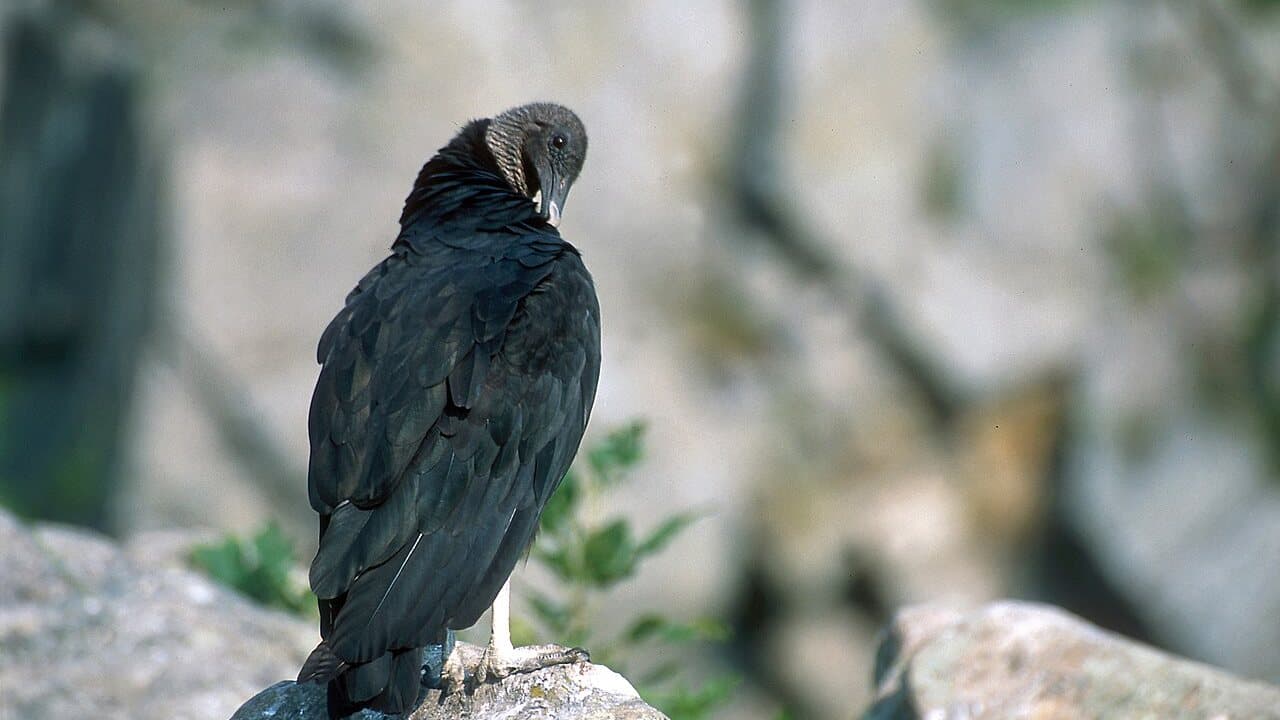
| A big dark eagle circling | Turkey vulture | Holds wings in a shallow V and rocks side to side. Two-toned underwing: dark front, silvery flight feathers. Small bare red head |
| An eagle on a pole by the highway | Red-tailed hawk | Pale chest with a band of dark streaks across the belly. Rusty tail on adults |
| A white-headed eagle near water | Osprey | White underneath, dark eye stripe through a white face, long narrow wings bent at the wrist in an M shape. Dives feet-first for fish |
Osprey or bald eagle at the water
Both birds fish, both nest near water, and both are big, so this is the confusion that happens at every lake and river. An osprey hovers over the water, then plunges in feet first and comes up with a fish held head forward. A bald eagle usually snatches fish from the surface in a shallow swoop without going under, and often steals fish from ospreys in midair. Osprey nests are bulky stick piles on top of utility poles, channel markers and nesting platforms built for them. Bald eagle nests are higher, in big trees. Ospreys leave most of the US in fall and return in spring; bald eagles stay, and winter is when they are easiest to see at open water below dams.
The golden eagle
The other eagle in the US is the golden eagle, a bird mostly of the West: open country, mountains, canyons and grassland. Adults are dark brown with a golden sheen on the back of the head and neck. Young golden eagles have white patches at the base of the flight feathers and a white tail with a dark band at the tip. Juvenile bald eagles are the main source of golden eagle reports in the East, and the difference is in the white: blotchy and scattered on a young bald eagle, clean and sharply defined patches on a young golden eagle.
A soaring bird, step by step
- Look at the wing angle. A steady V that rocks: turkey vulture. Flat and still: eagle or hawk. Bent at the wrist in an M: osprey.
- Look at the head. Big head sticking well out front: eagle. Tiny head: vulture. Short head: hawk.
- Judge size against something known. If a crow is nearby, an eagle dwarfs it; a red-tail is only somewhat larger. Crows often chase both.
- Look underneath. Belly band of dark streaks and a dark bar on the leading edge of each wing: red-tailed hawk. Dark brown with white blotches: young bald eagle. Clean white head and tail: adult bald eagle.
- Check the setting. Large water nearby makes eagle and osprey more likely. Highway shoulders, fields and suburbs make red-tail more likely.
Calls, and the movie scream
The fierce, raspy scream you hear when an eagle appears in a film or commercial is almost always a red-tailed hawk. Bald eagles make a weak series of high chirps and whistles that sound oddly small for the bird, so sound editors swap in the hawk. In the field this helps: a long, descending "keee-arrr" scream over a field is a red-tailed hawk, and a giggling, chattering series of thin whistles near water is a bald eagle.
Nests
| Bald eagle | Red-tailed hawk | |
|---|---|---|
| Size | Often 5 to 6 feet across and several feet deep; reused and added to for years | About 2 to 3 feet across |
| Location | Top of a very tall tree, usually within sight of water | High in a tree, on a cliff ledge, or on a tower or billboard |
| Season | Nesting starts in winter in much of the US | Spring |
A huge stick nest the size of a small car in a tall tree by a river is an eagle nest. Many are monitored by local birding groups and state wildlife agencies, which is a good way to confirm what you are seeing.
Photographing a raptor
Birds of prey are usually far away and often against a bright sky, which produces silhouettes. The bird identifier does well with a perched bird in decent light, where it can see the chest pattern, head and tail, and with flight photos taken from below when the underwing pattern is visible. It does poorly with dark silhouettes, heat shimmer over fields, and birds that are a few pixels wide after zooming. Expose for the bird rather than the sky, and take a burst; one frame with the wings spread is worth ten with them folded.
Other hawks people meet
- Cooper's hawk and sharp-shinned hawk: smaller, long-tailed hawks that hunt songbirds at backyard feeders. They are the hawks people see in suburbs grabbing birds, and they are nowhere near eagle size.
- Red-shouldered hawk: a forest and suburb hawk of the East and California, with reddish barred chest and loud repeated calls.
- Northern harrier: glides low over fields with wings in a slight V, white patch at the base of the tail.
One legal note: bald and golden eagles are protected under federal law, and nearly all other hawks under the Migratory Bird Treaty Act. Keeping a feather you found, disturbing a nest, or harassing a bird can be illegal, so photograph and leave them.
Big black birds without the raptor shape are covered in the crow vs raven guide.
Frequently asked questions
How big is an eagle compared to a hawk?
A bald eagle has a wingspan of about 6 to 7 1/2 feet and weighs 6 to 14 pounds. A red-tailed hawk, the most common large hawk, has a wingspan of about 4 feet and weighs 2 to 3 pounds. An eagle is roughly four times heavier.
What does a young bald eagle look like?
Young bald eagles are mostly dark brown with irregular white blotches on the body and underwings. They take about five years to get the white head and tail, so a big brown bird near water may well be a bald eagle.
Is a turkey vulture an eagle?
No. Turkey vultures are dark, eagle-sized birds that hold their wings in a shallow V and rock side to side in flight. Up close they have a small, bare red head. They are often mistaken for eagles.
Are hawks and eagles related?
Yes. Both belong to the same family, Accipitridae. The split between hawks and eagles is mostly about size and build rather than a strict scientific line.