Crow vs Raven: How to Tell Them Apart
A raven is a bigger, shaggier, wedge-tailed bird that croaks and soars. A crow is smaller, sleeker, fan-tailed and caws. Both are all black, which is why people swap the names, but once you know what to look at they are not hard to separate. The useful order is by distance: some marks work at a quarter mile, others only when the bird is on a fence post in front of you.
From far away
| Mark | Raven | Crow |
|---|---|---|
| Tail shape in flight | Wedge or diamond, longest feathers in the middle | Fan, with a rounded or squared end |
| Flight style | Soars and glides for long stretches, rides thermals like a hawk, does barrel rolls | Steady rowing wingbeats, rarely soars for long |
| Wing shape | Long, pointed, with long separated "fingers" at the tips | Shorter and blunter |
| Group size | Alone or in pairs; young birds gather at food and roosts | Family groups, and winter roosts of hundreds or thousands |
The tail is the single best long-distance mark. When a black bird banks overhead and its tail fans out, look at the end. A point in the middle means raven. A smooth curve means crow. It only works in flight, because a folded tail looks the same on both.
At medium distance
| Mark | Raven | Crow |
|---|---|---|
| Length | About 22 to 27 inches | About 16 to 21 inches |
| Wingspan | About 3 1/2 to 4 1/2 feet | About 3 feet |
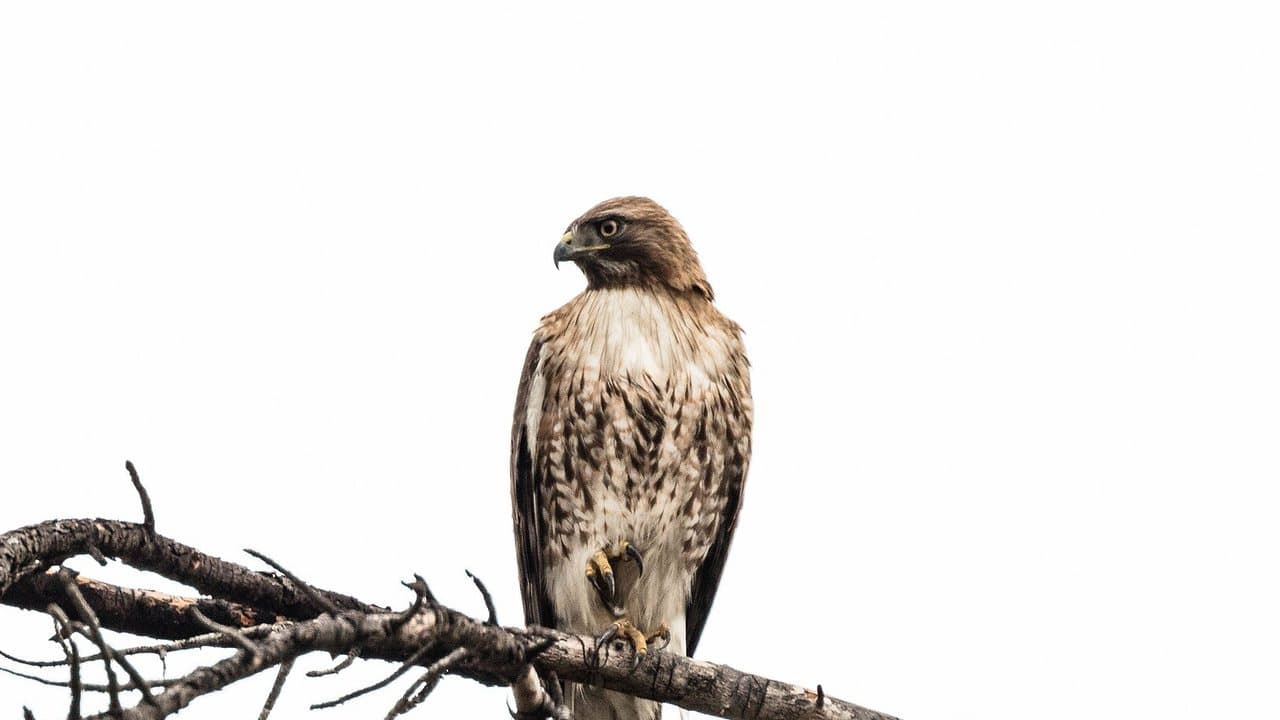
| Size comparison | Similar to a red-tailed hawk | Clearly smaller than a hawk |
| Walk | Heavy, deliberate strut; often hops sideways | Brisk walk |
Size is the mark people rely on most and trust least, because there is rarely anything nearby to compare against. A lone black bird on an empty field can look huge or small depending on how far away you think it is. Size works when the bird is next to something you know: a car, a fence post, a gull, or another crow.
Up close
| Mark | Raven | Crow |
|---|---|---|
| Beak | Large, deep and curved, with long bristles covering much of the top | Smaller and straighter, proportioned to the head |
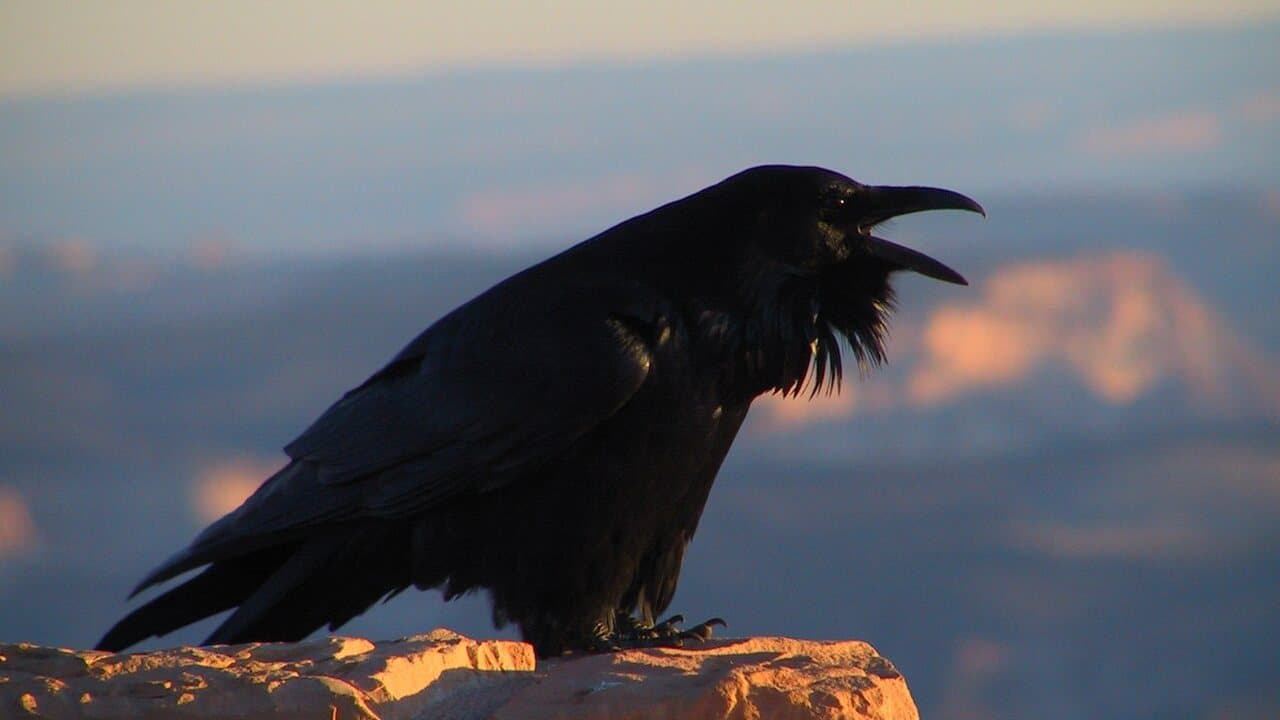
| Throat | Shaggy, with long pointed feathers (hackles) that puff out when it calls | Smooth |
| Head shape | Flat-topped, with the beak making the head look long | Rounded |
| Gloss | Purple-blue sheen in sun | Purple-blue sheen in sun; not a useful difference |
A perched silhouette adds one more clue. On a sitting raven, the folded wingtips reach close to the end of the tail, and the bird looks long and heavy at the front. On a sitting crow, the tail sticks out well past the wingtips and the body looks more compact. It is subtle, but it works on a bird on a distant power line where you cannot see the beak.
The beak and the throat feathers are the close-range clinchers. A raven's bill looks oversized, almost like it belongs on a bigger bird, and the ruff of feathers at its throat is obvious when it calls. A crow looks neat by comparison.
By ear, which beats all of the above
If you hear the bird, you can stop looking. Crows make the familiar clear "caw, caw." Ravens make a deep, hoarse croak, a rolling "gronk" or "kraa," plus a variety of knocks, gurgles and bell-like notes. Once you have heard both, you will not confuse them. Young crows begging can sound rough and nasal, which is the one regular source of confusion; they also sound higher than any raven.
On the Atlantic and Gulf coasts there is a third bird to rule out: the fish crow, which looks almost identical to the American crow and is best told by its nasal "uh-uh" call. The northwestern crow of the Pacific coast, once treated as its own species, is now considered the same species as the American crow, so you no longer need to separate it. In the desert Southwest, the Chihuahuan raven is a smaller raven that overlaps with the common raven and is hard to separate without hearing or seeing the white bases of its neck feathers.
Behavior that gives them away
| What it is doing | More likely |
|---|---|
| Walking a lawn in a loose group, probing the grass for grubs | Crow |
| Several birds diving at a hawk or owl and cawing loudly | Crow; mobbing predators is a crow specialty |
| Thousands of birds streaming into trees at dusk in winter | Crow roost |
| Two birds flying close together, tumbling and rolling in the air | Raven pair |
| Soaring high in circles on a thermal, alone or with hawks | Raven |
| Picking at roadkill on a remote highway | Raven, though crows scavenge too |
| Raiding trash at a campground or trailhead in the West | Raven |
Ravens also play: they slide down snowy roofs, drop and catch sticks in flight, and hang upside down from branches. Crows are clever too, but their style is collective. A crowd of noisy birds is crows. A single bird that seems to be entertaining itself is often a raven.
Where you are
| Setting | More likely |
|---|---|
| Suburban lawns, school fields, parking lots in the East and Midwest | Crow |
| Farm fields with a big flock | Crow |
| Mountains, canyons, high desert, sea cliffs | Raven |
| National parks in the West, roadsides with roadkill | Raven |
| Western cities and towns | Either; ravens are now common in many |
| A single big black bird soaring with hawks | Raven |
Ravens were pushed out of much of the eastern US in the 1800s and have been coming back, especially in the Appalachians and the Northeast. So an eastern raven is no longer unusual, but a flock of large black birds on a suburban lawn in Ohio is still crows.
Photographing it
A photo of a black bird is harder to identify than most people expect. Black feathers hide detail, a perched bird gives no sense of scale, and the tail shape only shows in flight. The bird identifier does well with a sharp, well-lit side view that shows the beak and throat, and with flight shots where the tail is spread. It does poorly with silhouettes against a bright sky, distant birds, and backlit shots where the bird is just a black shape. If you can record the call instead, do it: a sound recording settles this pair more reliably than any photo.
Two quick photo tips that improve the result: expose for the bird, not the sky, so the feathers keep some detail, and take a burst when it takes off so one frame catches the tail spread.
Myths worth dropping
- "Ravens are evil, crows are fine" or the reverse. Both are intelligent, social birds that solve problems and recognize individual people.
- "A crow is a young raven." They are different species from hatching. A young raven is already raven-sized when it leaves the nest, with the same heavy bill.
- "Ravens only live in the wilderness." That was close to true a century ago. Today ravens nest on buildings, billboards and highway signs in many western towns, and they are spreading east.
- "Count the primary feathers." You will see claims that ravens show five fingers and crows four. Feather counts vary with molt and angle; use the tail and wing shape instead.
For the other big birds people misname overhead, the hawk vs eagle guide covers the raptors.
Frequently asked questions
Is a raven just a big crow?
No. Both belong to the genus Corvus, but the common raven and the American crow are separate species with different voices, shapes, habits and ranges. A raven is roughly the size of a red-tailed hawk; a crow is noticeably smaller.
What is the easiest way to tell a crow from a raven?
Watch the tail in flight. A raven's tail is wedge-shaped, pointed in the middle. A crow's tail is fan-shaped with a rounded or square end. If you can hear it, a deep croak means raven and a clear caw means crow.
Do ravens live in cities?
Increasingly, yes. Ravens are birds of wild country, mountains, desert and coast, but they now live in many western cities and are spreading back into parts of the East. Crows are still far more common in towns and suburbs.
Are crows and ravens ever seen together?
Yes, and that is when you can compare them best. They often chase each other, and the size difference is obvious when both are in the air.