2026-07-02
What Are These Tiny Flying Bugs in My House? Identify by Where They Swarm
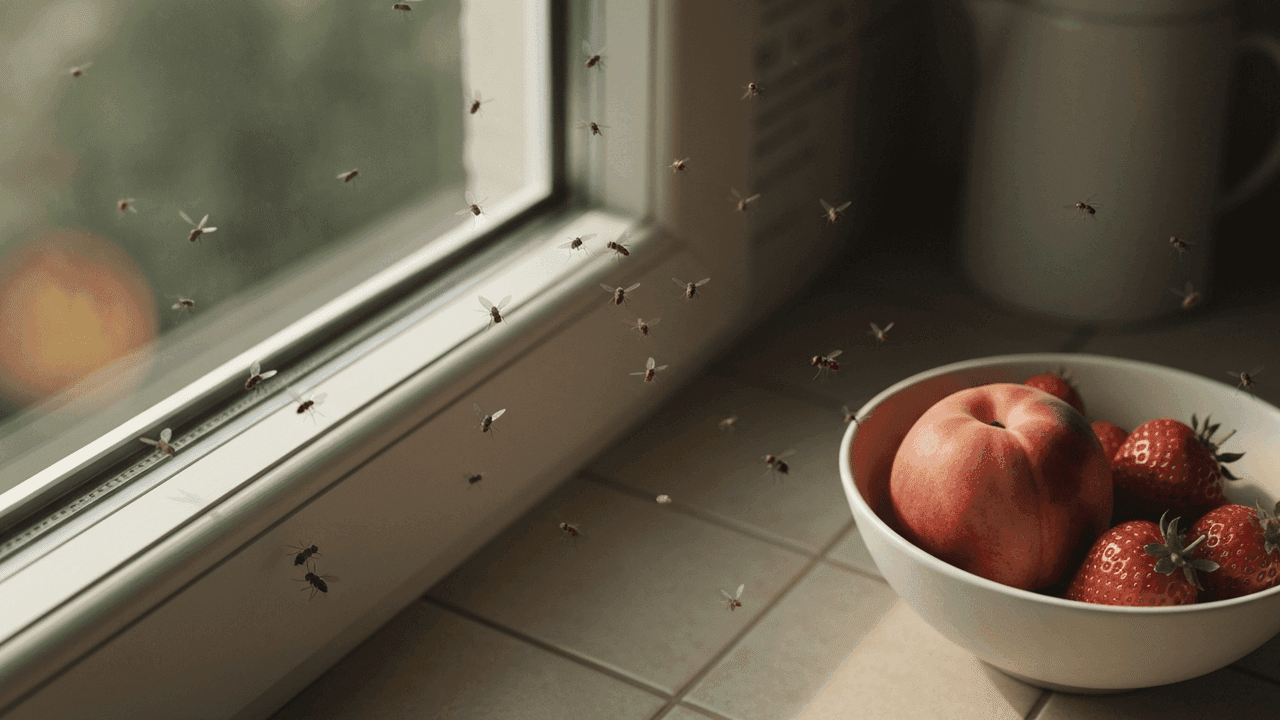
Tiny flying bugs indoors come down to six usual suspects. Two breed in your food or fruit, two breed in damp soil or drains, and two are the winged form of a much bigger problem. Where they gather tells you which, and the last pair is the one you do not want to guess wrong on.
Location decision table
| Where they swarm | Most likely | What it means |
|---|---|---|
| Over fruit, wine, or the recycling bin | Fruit fly | Fermenting sugars nearby |
| Crawling up from a houseplant | Fungus gnat | Overwatered soil |
| On the wall near a sink or shower drain | Drain fly | Organic film in the pipe |
| Near a bathroom or a slow leak, jerky flight | Phorid fly | Possible broken drain line |
| A sudden swarm at a sunny window in spring | Winged ant or termite | A nearby colony is reproducing |
The nuisance four
Fruit flies are tan with red eyes and hover in tight loops over anything fermenting. Remove the food source and set an apple-cider-vinegar trap (vinegar plus a drop of dish soap to break the surface tension). Gone in days.
Fungus gnats are darker, weaker fliers that stay low around plants. The adults are harmless; the larvae in the soil are the issue. Let the top inch of soil dry fully between waterings, add yellow sticky cards, and they collapse within two weeks. The full larval story is in the plant-soil worms post.
Drain flies (moth flies) are fuzzy and land in a little V on the wall near a drain. Counter sprays do nothing because they breed in the slime film inside the pipe. Scrub the drain with a brush, then pour an enzyme cleaner overnight, or boiling water plus dish soap weekly until they stop.
Phorid flies look like fruit flies but fly in fast, erratic zigzags and run across surfaces instead of flying when disturbed. They matter because they often breed in a cracked drain pipe or sewage under a slab. If you have persistent phorid flies with no obvious food source, suspect a plumbing leak and get it checked.
The pair you must not confuse: winged ant vs termite swarmer
A sudden indoor swarm of small flying insects at a window, especially in spring, is a reproductive flight from a colony. Telling ant from termite is the single most valuable bug ID a homeowner can make, because one is a nuisance and the other is eating your house.
| Feature | Winged ant | Termite swarmer |
|---|---|---|
| Waist | Pinched, narrow "wasp waist" | Straight, no waist, uniform width |
| Antennae | Bent / elbowed | Straight, bead-like |
| Wings | Front pair longer than back pair | Four wings all the same length |
| Wings after landing | Stay attached | Shed easily, piles of wings on sills |
If it has a straight waist, straight antennae, and four equal wings, or you find little piles of discarded wings on a windowsill, treat it as termites and call an inspector. The cost of a wrong guess here is measured in thousands of dollars.
When the identifier helps
The ant-versus-termite call is exactly the kind of high-stakes, hard-to-eyeball ID worth confirming with a photo. Capture one at maximum zoom and run it through the bug identifier, then verify with a professional if it points to termites. For the nuisance flies, the table above is faster than any app, since the fix is about the breeding site, not the species.